Is Tide Toxic? The Chemical No Ingredient List Will Ever Show
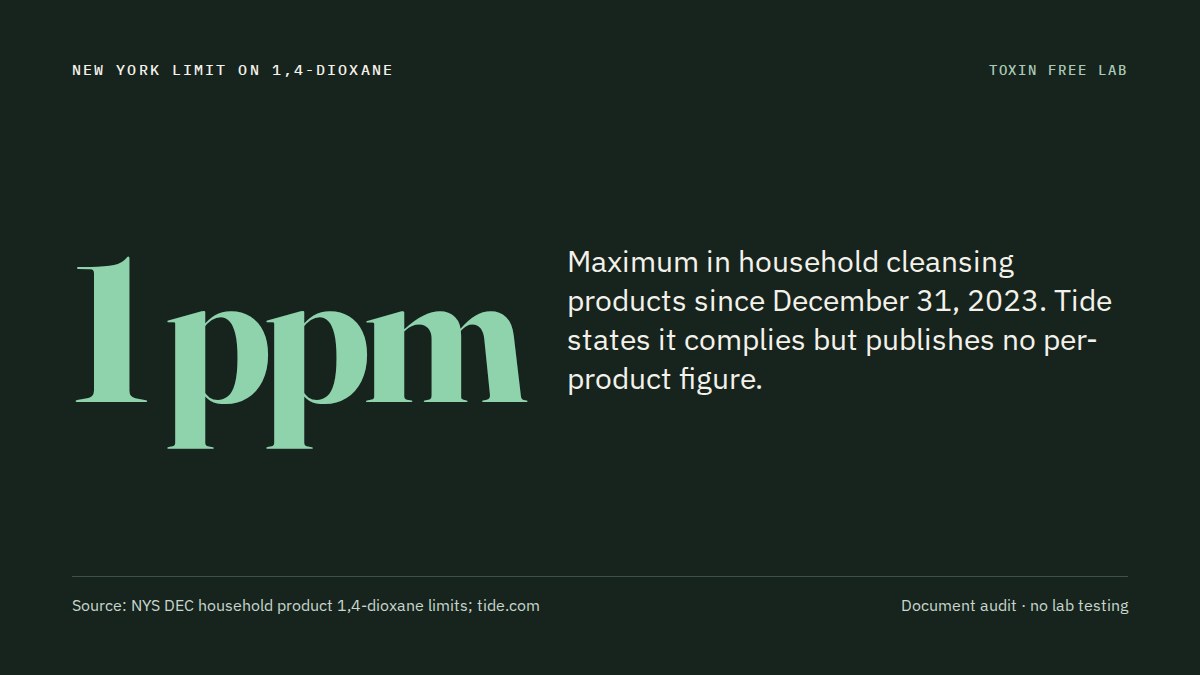
Is Tide toxic? The ingredient behind most “Tide is toxic” claims, 1,4-dioxane, will never appear on a Tide ingredient list. It is not added; it forms as a byproduct when some surfactants are ethoxylated. What Tide does disclose are the ethoxylated ingredients where it can originate. Since December 31, 2023, New York caps 1,4-dioxane in household cleansing products at 1 ppm, and Tide states its products comply.
Methodology: this audit is built from Procter & Gamble’s published safety data sheets, Tide’s own statements, New York State DEC regulations, FDA and EPA classifications, and CPSC injury reports. Toxin Free Lab performed no testing of any Tide product and has no access to the fragrance formulation.
Why the Chemical Everyone Asks About Is Not on the Label
Search for Tide’s ingredients and you will find surfactants, enzymes, brighteners, fragrance and dye. Search that list for 1,4-dioxane and you will find nothing. Both results are accurate, and neither settles the question.
The FDA explains that 1,4-dioxane “forms as a byproduct during the manufacturing process” of ethoxylated ingredients, and because it is not an intentional ingredient it does not appear on labels. The same page gives readers the tell: ingredient names containing “PEG”, “polyoxyethylene”, “-eth-” or “-oxynol-“.
Here is where Tide’s own paperwork becomes useful. P&G’s safety data sheet for Tide Pods (dated February 2011) lists “Nonionic surfactants (Alcohols Ethoxylated)” at 7–13% and “Ethoxylated polyethylene polyamine” at 3–7%. The liquid Tide data sheet (revised April 2015) lists nonionic surfactants at 1–5% within an anionic surfactant load of 10–30%.
So the honest reading is this. Tide discloses the ingredient class that can carry 1,4-dioxane. It cannot disclose a byproduct level on an ingredient list, because that is not what an ingredient list records. The number a buyer would actually want lives somewhere else.
The 1 ppm Rule Most Tide Articles Leave Out
The best-known 1,4-dioxane story about Tide is a decade old. As You Sow reports that it sued Procter & Gamble under California’s Proposition 65, and that in a settlement dated January 24, 2013, P&G agreed to reformulate its laundry detergents so 1,4-dioxane levels fell below California’s No Significant Risk Level, with reformulated products nationwide by September 2013. As You Sow’s page does not publish a concentration figure.
The more recent, and more specific, constraint is New York’s. The New York State DEC sets a maximum of 2 ppm for household cleansing products from December 31, 2022, dropping to 1 ppm from December 31, 2023. Manufacturers could apply for waivers, but the DEC states that “no waiver will be effective after December 30, 2025.” In September 2024 the DEC finalized regulations setting a standardized method for measuring it.
On its ingredient process page, Tide states its products comply with “the New York state 1,4 dioxane requirements.” That is a claim of compliance with a published ceiling, not a disclosed measurement. Tide does not publish a per-product 1,4-dioxane figure on that page.
Why the chemical matters to regulators at all: the EPA classifies 1,4-dioxane as “a Group B2, probable human carcinogen,” and the FDA notes the National Toxicology Program considers it “reasonably anticipated to be a human carcinogen.” New York’s stated driver is groundwater, where the DEC says it persists and requires “complex and costly treatment technologies” to remove. Those classifications describe the chemical, not a finding about Tide.
The practical consequence: anyone repeating 2013-era Tide dioxane figures is describing a formula that a settlement and a state law have both since pushed on. The remaining gap is disclosure, not a known exceedance.
What P&G Discloses and What It Withholds
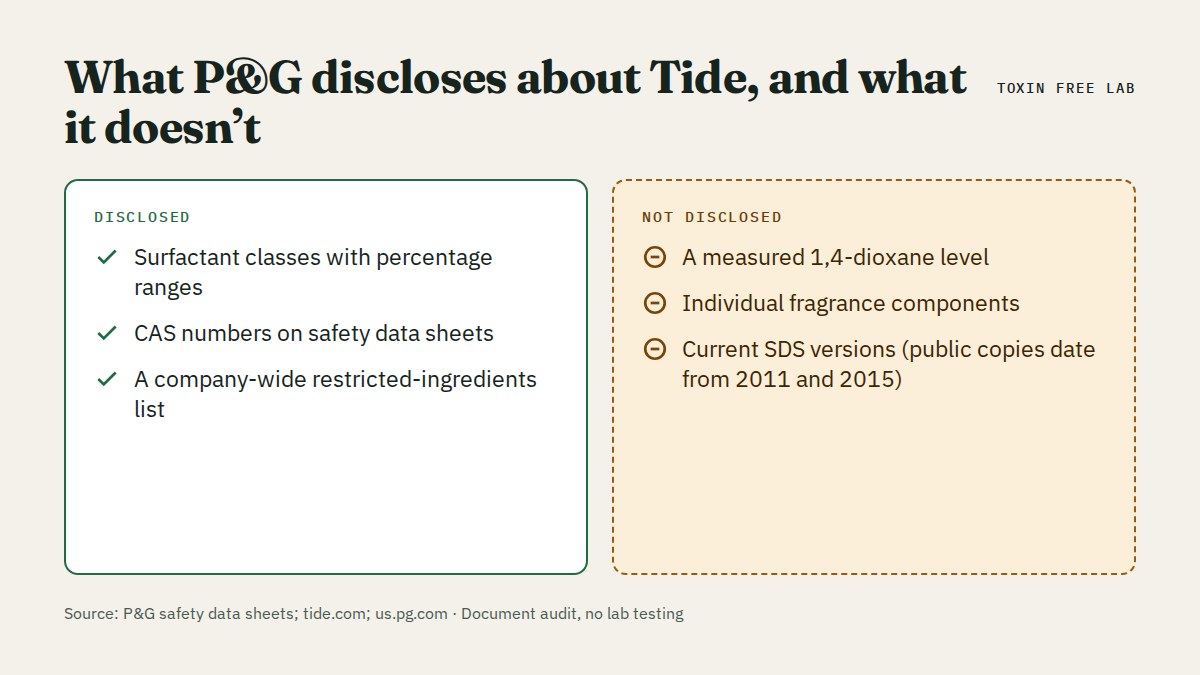
Credit where it is due: P&G publishes more than most mass-market brands. Its data sheets give CAS numbers and percentage ranges, and Tide links to a restricted-ingredients list covering all P&G products. The gaps are specific.
| Item | Status | Where it appears |
|---|---|---|
| Anionic surfactants | Disclosed as a range (10–30%, liquid) | P&G liquid data sheet, 2015 |
| Ethoxylated nonionic surfactants | Disclosed as a range (7–13%, Pods) | P&G Pods data sheet, 2011 |
| Ethanol, ethanolamine | Disclosed with CAS and range | P&G liquid data sheet, 2015 |
| 1,4-dioxane level | Not published; compliance with NY cap stated | Tide ingredient process page |
| Fragrance components | Listed as “fragrance” | Retail ingredient panels |
| Restricted substances | Published company-wide | P&G ingredients site |
Two limits to note. The data sheets are dated, and formulas change; a 2011 Pods sheet describes a 2011 product. And “fragrance” remains one word covering a blend buyers cannot see. SkinSAFE, which screens against a Mayo Clinic-derived allergen list, flags fragrance and formaldehyde on its Tide Original entry, while noting its ingredient data was last updated in December 2017. People with a known fragrance allergy have a concrete reason to check the unscented lines, and an allergist or other qualified clinician is the right person to confirm what to avoid.
For comparison, our Dawn dish soap ingredient audit covers another P&G brand with the same byproduct question, and the Seventh Generation audit shows how a brand built around disclosure handles it.
Pods Are a Different Hazard: the Packet, Not the Formula
The acute, documented harm tied to Tide-style detergent is not long-term exposure. It is small children biting concentrated packets. P&G’s own Pods data sheet tells anyone who swallows the contents to “call a Poison Control Center or doctor immediately. DO NOT INDUCE VOMITING.”
The CPSC’s June 2018 report tracked emergency department visits for children under 5 before and after the voluntary standard ASTM F3159 took effect by December 2016. That standard added opaque packaging, a bittering agent, burst resistance and warning labels.
The arithmetic is worth reading carefully. Raw visits fell only from about 4,200 to 3,900, roughly 7%. The CPSC’s headline 58% drop is per unit sold. Packets became far more common, so each packet became less likely to send a child to hospital, but the total count stayed in the thousands. These figures cover all brands of liquid laundry packets, not Tide alone.
For a household with toddlers, that is the risk worth acting on: storage and packaging, not the ingredient list. Liquid detergent from a jug carries the same data-sheet ingestion warnings but not the bite-sized, concentrated format.
Reading Tide’s Own “Are Detergents Toxic?” Argument
Tide publishes its own answer, and it deserves a fair reading. Its core argument, that risk equals hazard multiplied by exposure, is the standard toxicology framing, and it is correct as a method. A concentrated surfactant in a cup is a different exposure from trace residue on a rinsed shirt.
Here is the complication. That page does not name 1,4-dioxane, does not mention New York’s limit, and does not cite poison control. It asks readers to trust an exposure assessment whose inputs they cannot see. The compliance statement on Tide’s separate ingredient page is more useful to a buyer than the whole essay, and the two are not linked in the way a reader would need.
If you want brands that publish more of the inputs, see our Method ingredient audit for a direct comparison of disclosure depth.
The Bottom Line
Tide discloses its surfactant classes, percentage ranges and a company-wide restricted list, which is more than many brands offer. It does not publish a 1,4-dioxane measurement; it states compliance with New York’s 1 ppm cap. The EPA classifies 1,4-dioxane as a probable human carcinogen, and the CPSC documents thousands of child ER visits a year from laundry packets across all brands. Fragrance remains undisclosed. For allergies, pregnancy, children or pets, read the current label and SDS and ask a qualified professional. This audit reflects documents, not testing.
Frequently Asked Questions
Does Tide contain 1,4-dioxane?
It will not appear on the ingredient list, because the FDA explains it forms as a manufacturing byproduct of ethoxylated ingredients rather than being added. P&G data sheets list ethoxylated surfactants. Tide states its products comply with New York’s limit of 1 ppm for household cleansing products, in force since December 31, 2023, but does not publish a per-product figure.
Was Tide sued over 1,4-dioxane?
As You Sow reports it brought a Proposition 65 action against Procter & Gamble. In a settlement dated January 24, 2013, P&G agreed to reformulate its laundry detergents to bring 1,4-dioxane below California’s No Significant Risk Level, with reformulated products available nationwide by September 2013.
Is Tide Free & Gentle non-toxic?
That is the question, not a verdict this audit can give. An unscented formula addresses fragrance, one of the ingredients allergen screeners flag on Tide Original, but it is still a surfactant detergent and the 1,4-dioxane question applies the same way. Check that product’s own SDS and label, and ask an allergist if you have a diagnosed sensitivity.
What happens if a child swallows a Tide Pod?
P&G’s Pods data sheet instructs: drink a glass of water or milk, “call a Poison Control Center or doctor immediately,” and do not induce vomiting. The CPSC estimated about 3,900 ER visits for children under 5 from all brands of laundry packets in 2017.
Where can I find Tide’s full ingredient list?
P&G hosts product-level ingredient pages on its SmartLabel site (smartlabel.pg.com), and a company-wide restricted-ingredients list at us.pg.com. Safety data sheets give hazardous components with CAS numbers and ranges. Formulas change, so match the document to the exact product and scent you own.
Checking something else?
Every audit here works the same way: what the manufacturer publishes, what independent bodies say about it, and what the label leaves out.
All brand auditsSearch by chemicalHow we audit