Are Bath & Body Works Candles Toxic? Their Own SDS Flags a Skin Sensitizer
Bath & Body Works’ own safety data sheet for one of its scented candles classifies the product as a Category 1 skin sensitizer and names seven hazardous fragrance components, yet the candle’s retail page describes only “a soy wax blend” and “premium lead-free wicks.” Whether that makes the candles toxic depends on exposure, which no label settles. What the record does show: every documented Bath & Body Works candle recall was a fire hazard, not a chemical one.
Methodology: this audit is built from Bath & Body Works’ published statements and safety data sheet, CPSC recall and rulemaking records, and peer-reviewed research. Toxin Free Lab performed no testing of any Bath & Body Works candle and has no access to proprietary formulas.
Key Findings
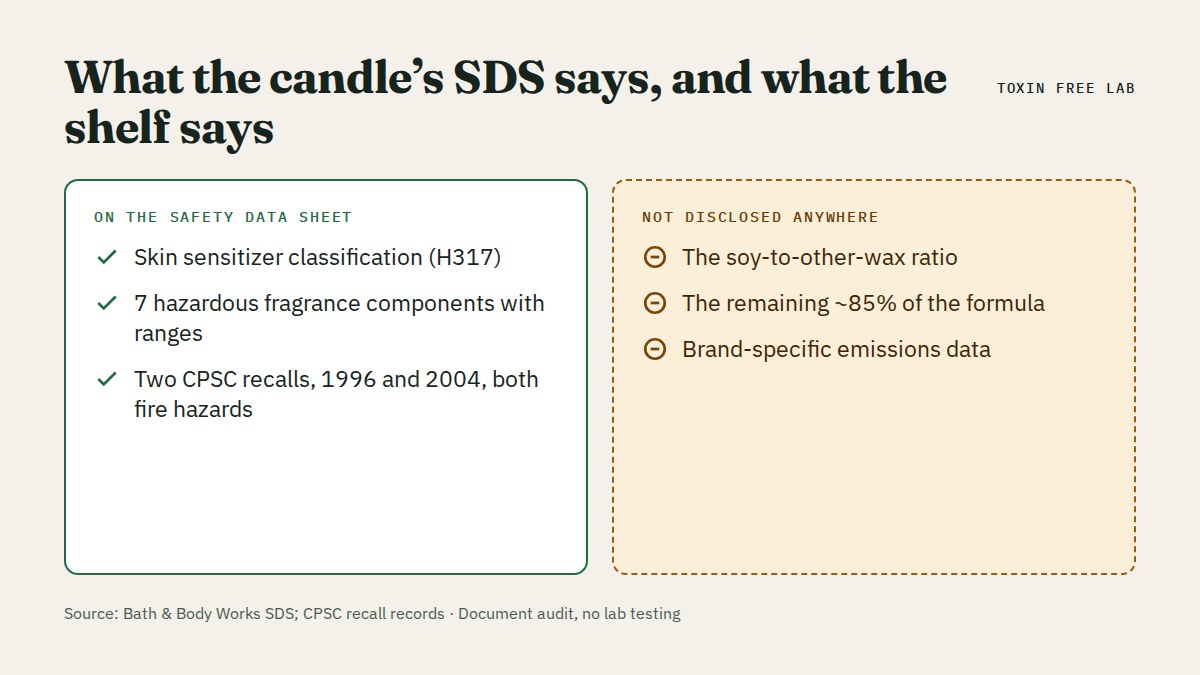
- The SDS is the most detailed disclosure the brand publishes. For the Mahogany Balsam candle it lists GHS classifications H317 (may cause an allergic skin reaction), H402 and H411 (aquatic toxicity).
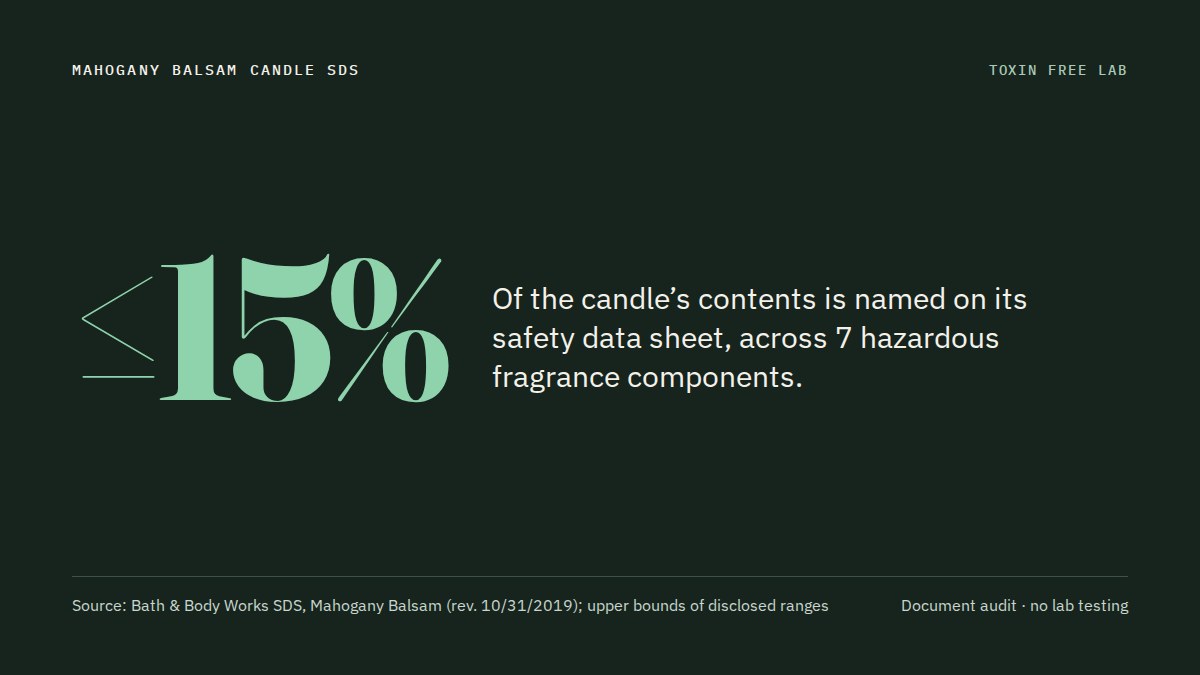
- At most about 15% of that candle’s composition is named. Two components are listed at 1–5% and five at under 1%. The wax base, and the ratio of soy to other waxes, is not stated.
- Recalls: two candle recalls on CPSC record, in 1996 and 2004, both for fire risk.
- Lead wicks have been banned in the US since 2003, and the brand states its wicks are lead-free.
What the Safety Data Sheet Discloses That the Shelf Does Not
The candle listing and the safety data sheet are written for different readers. The listing is for shoppers: it says the candles are “crafted with a high concentration of rich fragrance oils in a soy wax blend and premium lead-free wicks.” The SDS is a regulatory document written for handlers and emergency responders, and it has to name components that trigger a hazard classification.
The Bath & Body Works SDS for the Mahogany Balsam scented candle (revision dated 10/31/2019) lists these hazardous components:
| Component (as listed) | CAS | Range |
|---|---|---|
| Octahydro-tetramethyl-naphthyl ethanone (a woody aroma chemical) | 68155-66-8 | 1–5% |
| 2,6-dimethyloct-7-en-2-ol (dihydromyrcenol) | 18479-58-8 | 1–5% |
| 2-ethyl-4-(2,2,3-trimethyl-3-cyclopenten-1-yl)-2-buten-1-ol | 28219-61-6 | <1% |
| Coumarin | 91-64-5 | <1% |
| Linalyl acetate | 115-95-7 | <1% |
| Linalool | 78-70-6 | <1% |
| Dimethylcyclohex-3-ene-1-carbaldehyde | 27939-60-2 | <1% |
Here is the arithmetic. Take the top of every range: 5% + 5% for the two larger components, plus under 1% for each of the other five, gives a ceiling just below 15%. So at least 85% of the candle’s mass is not itemized on its most detailed public document. Most of that is wax, which is expected, but the sheet does not say what share is soy and what share is anything else.
To be fair to the brand, SDS rules only require hazard-triggering components to be named. A non-hazardous wax does not have to appear, and Bath & Body Works publishes the sheet openly, which many candle makers do not. The gap is between the two documents: the shelf copy names none of these compounds, and the SDS never names the wax.
How Named Bodies Classify the Listed Ingredients
The classification on the sheet is the brand’s own, under the Globally Harmonized System. H317 means the mixture “may cause an allergic skin reaction,” and the SDS adds that it “may cause skin sensitization or allergic reactions in sensitive individuals.” That hazard concerns contact with the wax or fragrance oil, such as handling spilled wax, not a statement about breathing air in a room where the candle burns.
The aquatic codes, H402 and H411, mean the brand classifies the product as harmful and toxic to aquatic life, the latter “with long lasting effects.” The practical consequence is disposal: leftover wax belongs in household trash, not a drain.
On combustion, the sheet is vague. It says thermal decomposition products “may include the following substances: Harmful gases or vapors,” and names none. That is a common SDS formula and gives a buyer nothing to check.
The Recall Record: Fire, Not Chemistry
Searches for this question often assume a recall for toxic fumes. The CPSC record does not show one. Two Bath & Body Works candle recalls appear on the agency’s site:
| Date | Product | Units | Hazard stated by CPSC |
|---|---|---|---|
| Sept 27, 1996 | Garden Lavender Botanical Candles | 18,400 | Dried flowers inside the candle may catch fire as it burns |
| Mar 18, 2004 | “Real Essence” votive candles | 733,000 | May burn with a high or irregular flame |
The 2004 notice records nine complaints of high-flame burning and two minor injuries. Neither recall involved ingredients. The brand’s newsroom statement says its candles “undergo extensive quality and safety testing under rigorous burn and use conditions” and lists burn rules: trim the wick to 1/4 inch, never burn longer than 4 hours, keep the candle in sight. The statement does not name the standards or publish test results.
On wicks, the old concern is settled by law. The CPSC banned lead-cored wicks in 2003 after finding some released lead above 3,000 micrograms per hour, and Bath & Body Works describes its wicks as lead-free.
What Research Says About Scented Candle Emissions
No published study we located tests Bath & Body Works candles by name, so the evidence is category-level. The most cited risk assessment, Petry et al., Regulatory Toxicology and Pharmacology (2014), measured emissions from nine scented and two unscented candles and concluded that “under normal conditions of use scented candles do not pose known health risks to the consumer.” Its usage model was about eight burns a month of two to four hours each.
That conclusion has critics. A 2023 commentary in Environmental Science & Technology (Singh, Kumari and Fatima) argues that VOC and SVOC emissions from scented candles are an underappreciated indoor-air risk. It is a comment piece, not new measurement data. Both positions are on record; neither addresses this brand’s formulas specifically.
Reviewers and forum users regularly describe headaches or irritation from strongly scented candles, and just as many describe years of use without problems. That split fits what the SDS says: sensitivity varies by person. Anyone with asthma, fragrance allergy, pets such as birds that are sensitive to airborne irritants, or an infant in the room should read the product’s SDS and ask a physician or veterinarian.
If you want a brand that publishes more, compare the disclosure approaches in our audits of Pura’s fragrance diffuser ingredient standard and Mrs. Meyer’s scented product ingredients, or the Method brand ingredient audit.
The Bottom Line
Bath & Body Works discloses more than its shelf copy suggests: its SDS names seven hazardous fragrance components and classifies the Mahogany Balsam candle as a skin sensitizer and an aquatic toxicant. It withholds the wax blend ratio and the full fragrance formula. Its recall history is about flames, not fumes. Whether the candles are toxic in your home is a question of exposure and personal sensitivity that no public document answers. Read the SDS for your specific scent, follow the burn rules, and ventilate.
Frequently Asked Questions
Are Bath and Body Works candles toxic to breathe?
No public data measures emissions from Bath & Body Works candles specifically. A 2014 risk assessment of scented candles found no known health risk under normal use, while a 2023 commentary argues emissions are underappreciated. The brand’s SDS lists combustion products only as “harmful gases or vapors.” People with asthma or fragrance sensitivity should consult a physician.
Do Bath and Body Works candles contain lead?
The brand states its candles use “premium lead-free wicks.” Separately, the US Consumer Product Safety Commission banned the manufacture and sale of candles with lead-cored wicks in 2003, so lead-cored wicks cannot legally be sold in the US.
What wax do Bath and Body Works candles use?
Bath & Body Works describes the wax as “a soy wax blend.” It does not publish what the soy is blended with or in what proportion, and the safety data sheet we reviewed does not itemize the wax, because SDS rules only require hazard-classified components to be named.
Have Bath and Body Works candles been recalled?
Yes, twice according to CPSC records: 18,400 Garden Lavender Botanical Candles in 1996 because dried flowers could ignite, and 733,000 “Real Essence” votives in 2004 for high or irregular flames. Neither recall concerned chemical ingredients or fumes.
Are Bath and Body Works candles bad for pets?
The brand publishes no pet-specific guidance we could find. Its SDS flags skin sensitization and aquatic toxicity, so keep pets away from lit candles and melted wax. Birds and animals with respiratory conditions warrant extra caution; ask your veterinarian before burning scented candles near them.
Checking something else?
Every audit here works the same way: what the manufacturer publishes, what independent bodies say about it, and what the label leaves out.
All brand auditsSearch by chemicalHow we audit