Non-Toxic Candles: Who Funded the Research on Your Wax
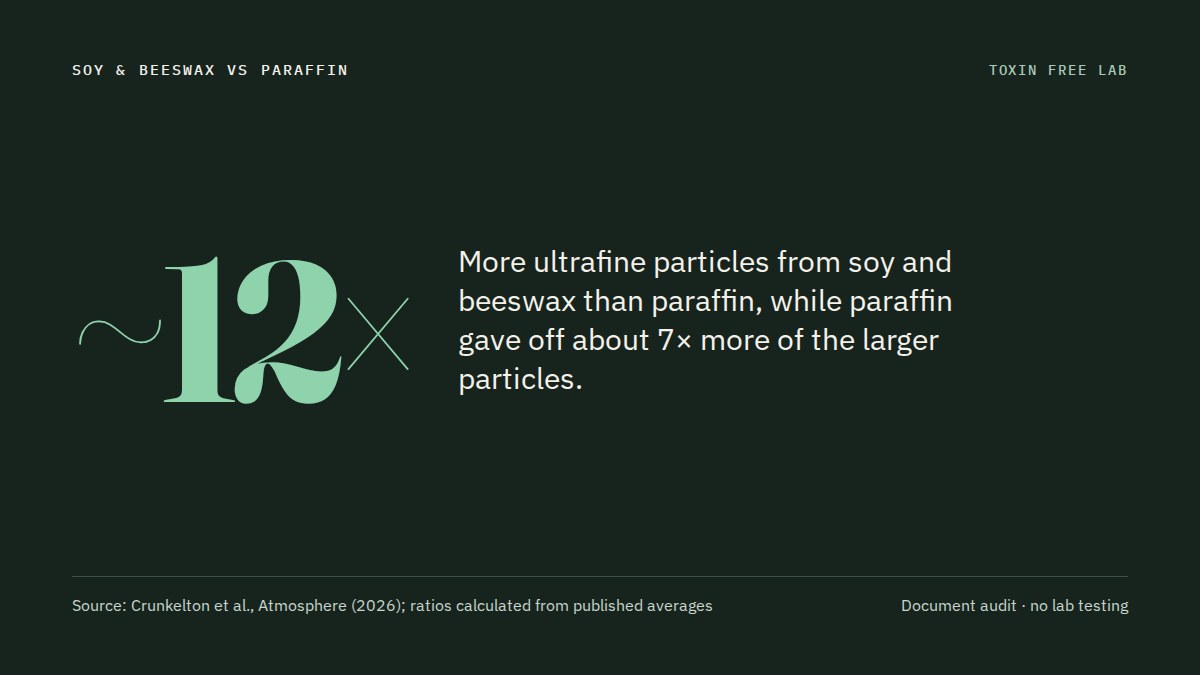
Short answer: No US rule defines a “non-toxic” candle, and the research does not rank waxes the way candle marketing does. The two studies most often cited to clear candles were funded by the fragrance and wax industries. The newest independent study, published in 2026, found soy and beeswax candles released about 12 times more ultrafine particles than paraffin, while paraffin released more of the larger particles. Wax type changes which particles you get, not whether you get them.
Methodology: Toxin Free Lab performed no testing for this page. Every emission figure below belongs to the researchers who measured it, and each study is linked so you can read it yourself.
What “Non-Toxic” Means on a Candle Label
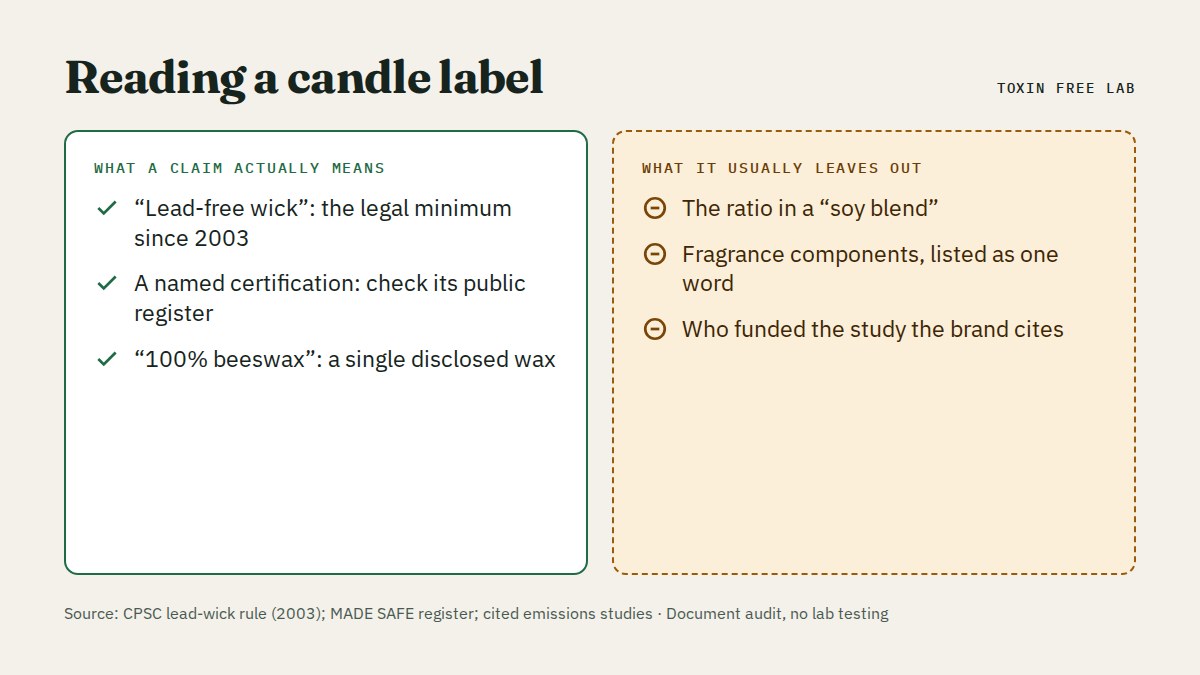
Nothing, legally. The Consumer Product Safety Commission’s business guidance for candles lists one hard chemical rule, on lead in metal-cored wicks, plus cautionary labeling where a candle contains a substance classed as hazardous under the Federal Hazardous Substances Act. The rest is a set of voluntary ASTM standards covering fire safety, glass containers and visible soot testing. None of them requires a candle maker to list its wax blend, its dyes or the components of its fragrance.
So “non-toxic candles” is a question buyers bring to the label, not an answer the label can give. What a label can tell you is how much the maker chose to disclose. That is the axis this guide uses, the same one applied in our Pura fragrance disclosure audit.
The Lead Wick Question Was Settled in 2003
Many candles still advertise “lead-free wicks” as a selling point. The claim is accurate and describes the legal minimum. The CPSC announced the ban on lead-cored wicks on April 7, 2003, covering both domestic and imported candles. The final rule took effect on October 15, 2003, and bans metal wick cores with “a lead content of more than 0.06 percent of the total weight of the metal core.” The Commission set that threshold because wicks at or below it did not produce detectable lead emissions in its laboratory findings.
Here is the practical consequence. A “lead-free wick” line tells you the candle obeys federal law. It does not distinguish it from any other candle legally sold in the US, and it says nothing about the wax or the fragrance.
Who Paid for the Studies Everyone Cites
Two studies carry most of the “candles are fine” argument. Both are real, both are useful, and both disclose industry funding.
The first, Petry et al., published in Regulatory Toxicology and Pharmacology in 2014, measured VOCs, PAHs, dioxins and fine particles from nine scented candles in environmental chambers and concluded that “under normal and foreseeable use conditions, the use of scented candles does not pose a safety concern to the consumer.” Its conflict-of-interest statement says funding came from a consortium organised by the Research Institute for Fragrance Materials, and several authors were affiliated with fragrance and consumer-goods companies. Every candle in it used paraffin wax. It cannot say anything about soy or beeswax.
The second, a 2007 study by the German lab Ökometric, compared paraffin, soy, stearin, palm and beeswax across more than 300 chemicals. The National Candle Association’s summary reports the waxes’ combustion byproducts were “virtually identical in composition and quantity.” Its funders included the National Candle Association, the European Wax Federation, a refiners’ association, paraffin producers, and Cargill, a soy wax supplier. Both sides of the soy-versus-paraffin marketing fight paid for it, which is a reasonable argument for its neutrality between waxes and none for its independence from the industry.
None of the top-ranking guides we reviewed names either funder.
Soy, Beeswax and Paraffin: What the 2026 Study Measured
The newest data comes from Crunkelton, Ilie, Seybold, Soo and Adhikari, published in Atmosphere in 2026. The team burned three paraffin candles and three natural candles (soy and beeswax) in a residential setting and measured particles across sizes, plus lung-deposited surface area, a metric for how much particle surface reaches the lungs.
Here is the complication. The results cut against the marketing in one direction and for it in another.
Ultrafine particles: natural candles averaged 8.4 × 10¹¹ per cubic metre, paraffin 7.0 × 10¹⁰. Divide one by the other and natural wax released 12 times more. Lung-deposited surface area: 195.2 versus 82.1 µm²/cm³, or 2.4 times higher for natural wax, a difference the authors report as statistically significant. Larger particles, 0.3 to 10 µm: paraffin reached 2.0 × 10⁷ versus 2.8 × 10⁶, about 7.1 times higher than natural wax. Total VOCs ran higher for natural candles, but not significantly.
Two cautions keep this in proportion. Three candles per group is a small sample, and a single study does not overturn a category. But it is the only peer-reviewed comparison we found that was not funded by candle, wax or fragrance makers, and it does not support the claim that switching to soy or beeswax removes particle emissions. Buyers choosing a wax to reduce what they breathe should know the evidence currently points in both directions depending on particle size.
| Study | Waxes covered | Funding disclosed | Headline finding |
|---|---|---|---|
| Ökometric, 2007 | Paraffin, soy, stearin, palm, beeswax | Candle and wax industry consortium incl. NCA, Cargill, Sasol Wax | Byproducts “virtually identical” across waxes |
| Petry et al., 2014 | Paraffin only (scented) | RIFM-organised fragrance consortium | No safety concern under normal use |
| Crunkelton et al., 2026 | Paraffin vs soy and beeswax | No industry funder identified | Natural wax: more ultrafine particles; paraffin: more 0.3–10 µm particles |
How to Compare Candles by Disclosure
If wax type does not settle the question, disclosure is the criterion a buyer can actually check. Fragrance is where most candle labels stop talking: one word can cover dozens of undisclosed components, the same pattern covered in our Mrs. Meyer’s ingredient audit and Method audit.
Level 4 has limits worth stating. Fontana Candle Co. describes its MADE SAFE certification as screening ingredients for carcinogens, endocrine disruptors, heavy metals, “harmful VOCs” and other hazard classes. That is an ingredient screen. The page does not say burn emissions were measured, and the 2026 data shows particles form in the flame regardless of what goes into the jar. For a certified example, Fontana’s essential oil candles appear on the MADE SAFE register, as do Natural Sloth beeswax candles.
Whatever you buy, burn behaviour matters as much as the label. The CPSC guidance points manufacturers to ASTM F2326 for visible emissions, which is soot. A trimmed wick, a draft-free spot and a ventilated room are the variables you control after purchase. Anyone with asthma or other respiratory conditions, or with birds or other pets in the room, should read the product’s safety information and ask a doctor or veterinarian about burning candles indoors.
The Bottom Line
“Non-toxic” on a candle is unregulated, and “lead-free wick” is the federal minimum. The studies cited to clear candles were industry-funded; the one independent comparison found natural waxes emit more ultrafine particles and paraffin more of the larger ones. Choose on what a maker discloses and whether a named certifier screened it, then control ventilation and wick length. Toxin Free Lab ran no tests; all emission data belongs to the cited researchers.
Frequently Asked Questions
Are soy candles non-toxic?
No agency classifies any wax as non-toxic. A 2007 industry-funded study reported soy and paraffin byproducts as virtually identical. A 2026 study in Atmosphere found soy and beeswax candles released about 12 times more ultrafine particles than paraffin, though paraffin released more larger particles. Soy changes the particle profile rather than removing emissions.
Do candles still have lead wicks?
Not legally in the US. A CPSC rule effective October 15, 2003 bans metal wick cores containing more than 0.06 percent lead by weight, for domestic and imported candles alike. A “lead-free wick” label confirms compliance with that rule. It does not set a candle apart from others legally sold in the US.
Are beeswax candles better than paraffin?
It depends on the measure. The 2026 Crunkelton study grouped beeswax with soy and found that group higher in ultrafine particles and lung-deposited surface area, while paraffin was about seven times higher in 0.3–10 µm particles. The sample was three candles per group, so treat it as a signal rather than a verdict.
What does MADE SAFE certification mean for a candle?
It means the ingredients were screened against MADE SAFE’s hazard list, which covers carcinogens, endocrine disruptors, heavy metals and harmful VOCs, according to Fontana’s description of its certification. That page does not say burn emissions were measured. Check the product on the MADE SAFE register rather than relying on a logo alone.
Are scented candles bad for pets or people with asthma?
Toxin Free Lab cannot answer that for any individual. Candles emit particles whatever the wax, and fragrance components are rarely disclosed. Read the product’s safety information, ventilate the room, and ask a doctor about respiratory conditions or a veterinarian about pets, especially birds, before burning candles near them.
Checking something else?
Every audit here works the same way: what the manufacturer publishes, what independent bodies say about it, and what the label leaves out.
All non-toxic productsSearch by chemicalHow we audit