Is Method Non-Toxic? The Claim S.C. Johnson Dropped
Key findings
- S.C. Johnson agreed to stop advertising three named Method products as non-toxic: the All-Purpose Cleaner, Squirt and Mop Floor Cleaner and Granite Cleaner.
- The related action settled for $2.25 million. A settlement is not a finding that the products are harmful.
- The complaint named six compounds, including methylisothiazolinone — Contact Allergen of the Year 2013, American Contact Dermatitis Society.
- The phrase still appears on other Method bottles. A labelling undertaking covers what it names and does not travel to the rest of a line.
- No US agency defines or certifies "non-toxic" for household cleaners — not the FDA, EPA or CPSC.
Method’s “non-toxic” label wasn’t quietly rebranded. It was legally challenged, and S.C. Johnson agreed to stop making the claim on three named products.
In May 2020 a class action accused the company of mislabelling three Method cleaners as “non-toxic,” and a related case settled for $2.25 million. That is a checkable court record, not a chemistry verdict, and the two get confused constantly by shoppers searching whether Method is non-toxic.
This article covers what the lawsuits alleged, which compounds were named, what “agreeing to stop” a label claim means in legal terms, and where the phrase still appears today. Toxin Free Lab builds brand audits by reading court filings, ingredient disclosures and regulatory records rather than running tests of its own.
What the lawsuit against S.C. Johnson actually claimed
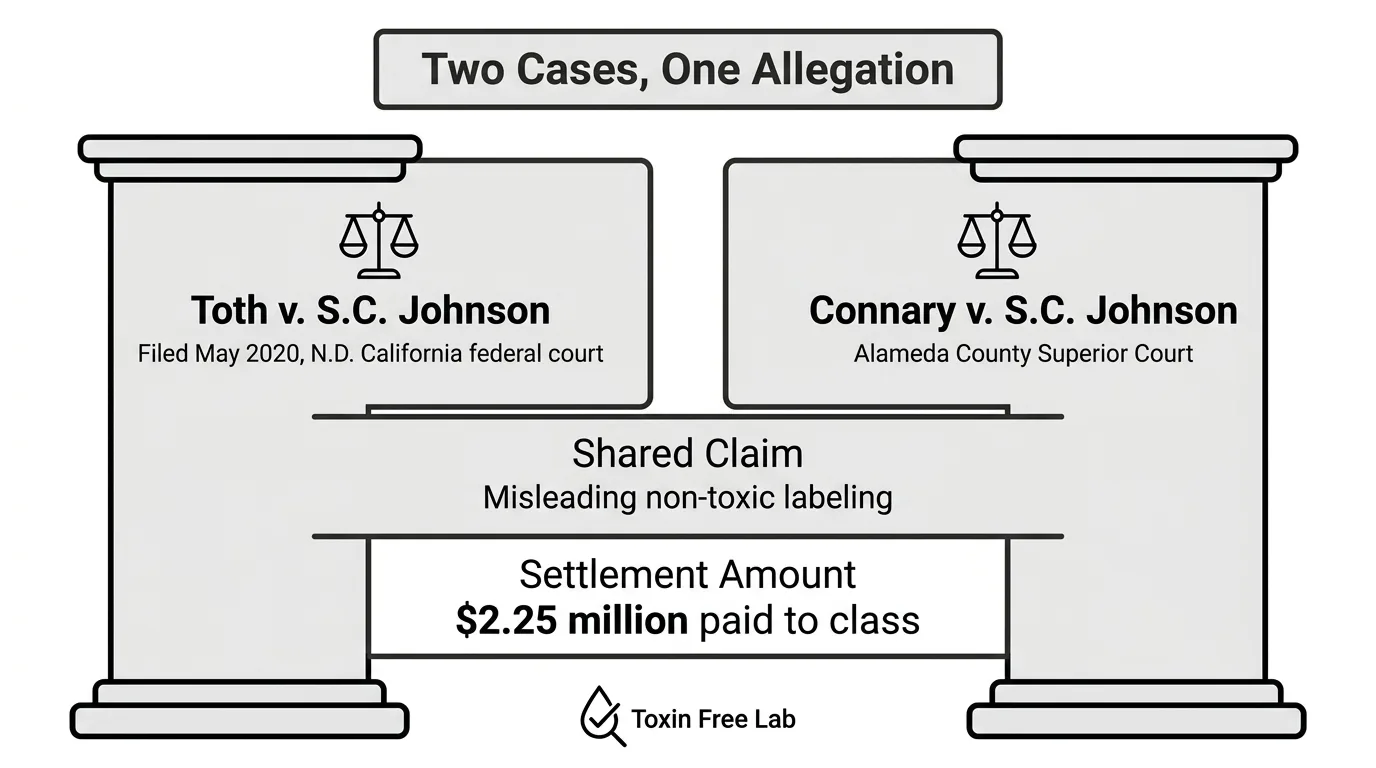
The Method “non-toxic” lawsuit centres on a 2020 federal complaint arguing the label misled reasonable consumers about specific ingredients. Toth et al v. S.C. Johnson & Son, Case No. 20-cv-3553, was filed in the US District Court for the Northern District of California in May 2020. The complaint argued that calling certain cleaners “non-toxic” was misleading because the formulas contained synthetic compounds tied to allergic and toxicological concerns, regardless of how the ingredients were sourced.
A related case, Connary et al v. S.C. Johnson & Son, Case No. RG20061675, ran through the Superior Court of California, Alameda County, and reached a resolution covering the same core allegation. That case settled for $2.25 million, paid to a defined class of US buyers. The figure reflects a negotiated resolution, not a jury’s damages calculation.
| Detail | Value |
|---|---|
| Federal complaint | Toth et al v. S.C. Johnson & Son, Case No. 20-cv-3553 |
| Court | US District Court, Northern District of California |
| Filed | May 2020 |
| Settled action | Connary et al v. S.C. Johnson & Son, Case No. RG20061675 |
| Court | Superior Court of California, Alameda County |
| Settlement fund | $2,250,000 |
| Class period | 14 May 2016 – 13 May 2021 |
| Products named | All-Purpose Cleaner, Squirt and Mop Floor Cleaner, Granite Cleaner |
| Company position | No admission of wrongdoing |
| Marketing change agreed | Covered products no longer advertised as “non-toxic” |
Which Method products and chemicals were named
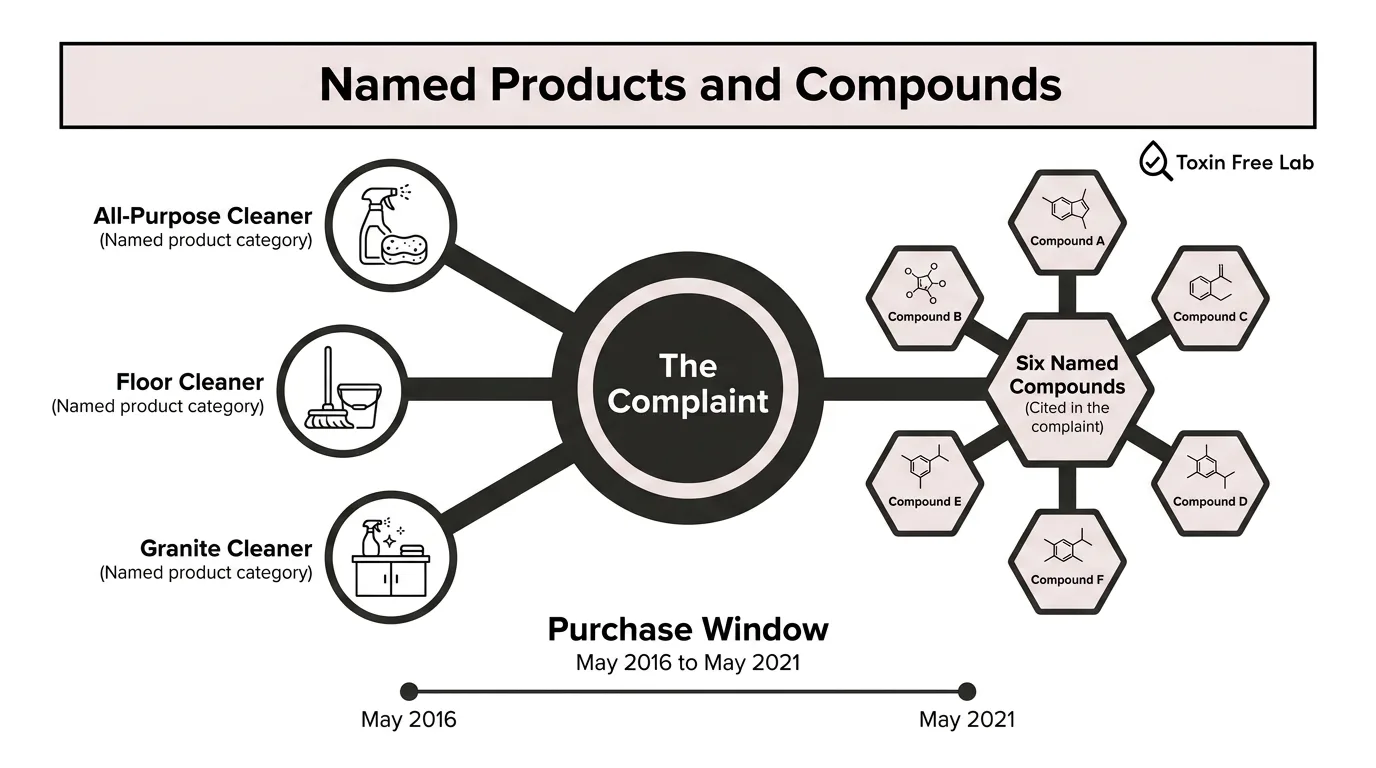
The complaint did not target Method’s entire catalogue. It named three specific products: the All-Purpose Cleaner, the Squirt and Mop Floor Cleaner and the Granite Cleaner. If you do not own one of these three, this particular legal record does not apply to your bottle directly — though the same regulatory gap around “non-toxic” applies across the category.
The complaint listed six compounds as the basis for its misleading-label theory: dipropylene glycol, phenoxyethanol, linalool, methylisothiazolinone, limonene and octylisothiazolinone. The settlement class covered purchases made between 14 May 2016 and 13 May 2021. Anyone who bought outside that five-year window is not part of this settlement, even for the same product.
What S.C. Johnson actually agreed to
Beyond the $2.25 million payment, S.C. Johnson agreed the covered products would no longer be advertised as “non-toxic.” That is a labelling commitment, separate from the money changing hands, and it is the detail most coverage of this story skips entirely.
A class-action settlement is a negotiated resolution both sides accept to close a case, not a judge or jury ruling on the underlying facts. Companies settle for many reasons, including the cost of continued litigation, and settling is common even where a company disputes the claims against it. So it is worth stating plainly, more than once: S.C. Johnson did not admit its products are harmful. It agreed to retire a specific, legally undefined marketing word on three named products.
Why “non-toxic” could be claimed, and challenged, in the first place
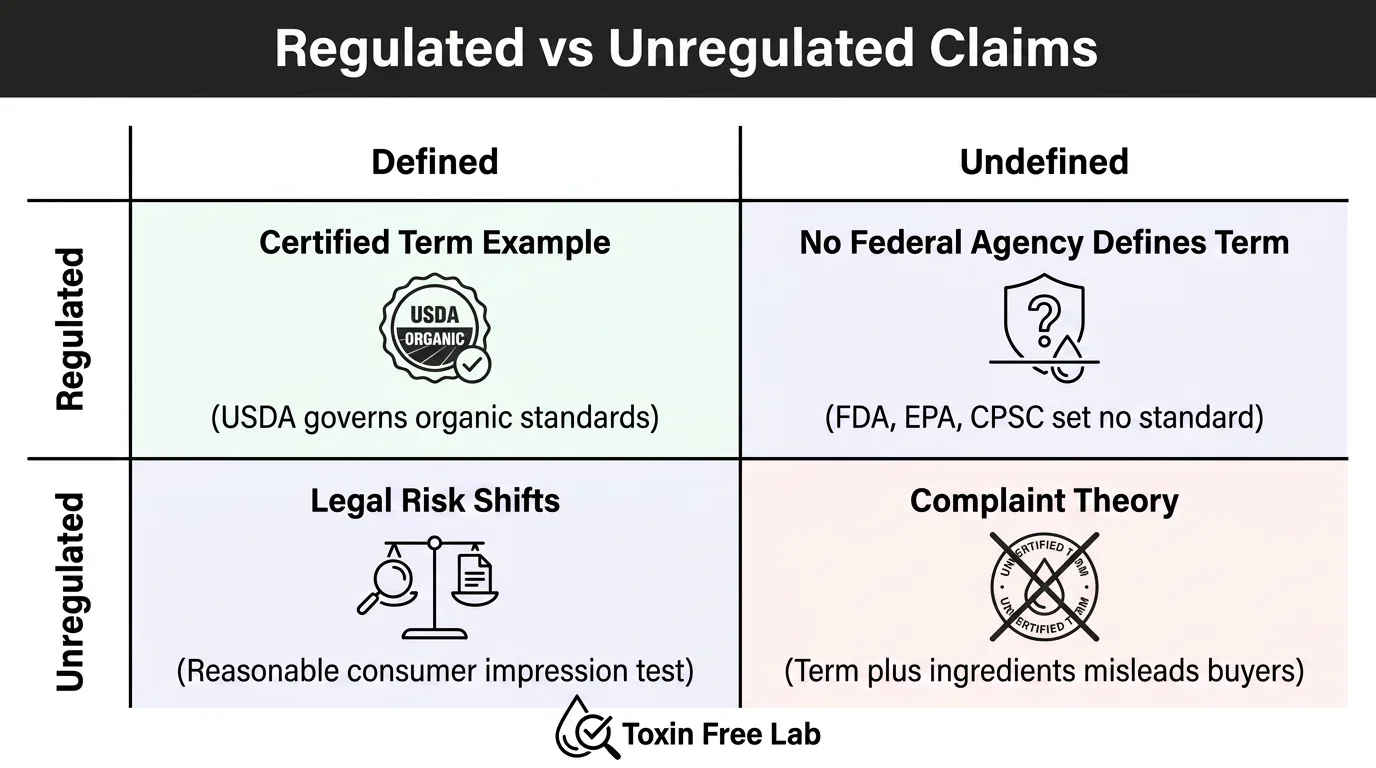
“Non-toxic” appears on cleaning labels because no US agency defines, certifies or regulates the term. Not the FDA, not the EPA, not the Consumer Product Safety Commission maintains a legal standard for what “non-toxic” must mean before a company prints it on a bottle. Compare that to “organic,” which the USDA governs through specific certification rules, and the gap becomes obvious.
Without a regulatory definition, legal risk shifts somewhere else: to whether the claim would mislead a reasonable consumer given what the product actually contains. That is the theory behind the Method complaint’s chemical list. The lawsuit did not argue Method broke a labelling law written for “non-toxic,” because no such law exists. It argued the word, paired with these specific named ingredients, created a false impression for buyers.
The same word has gone the other way elsewhere. In 2025 the National Advertising Division reviewed a cookware brand’s use of “non-toxic” and found it substantiated for that company’s own products — while striking down what the brand said about competitors. Same undefined term, two adjudicated outcomes: Caraway kept the claim after review, and S.C. Johnson agreed to drop it. Neither outcome tells a shopper whether a product is safe.
The chemicals named, in context
Methylisothiazolinone, often shortened to MI or MIT, is a preservative the American Contact Dermatitis Society named its Contact Allergen of the Year for 2013, announced in the journal Dermatitis. Our Dawn dish soap audit and Mrs. Meyer’s brand audit both cover its chemistry and allergen classification in more depth, since it appears repeatedly across the cleaning category rather than only in Method’s formulas.
Linalool and limonene are recognised fragrance allergens that commonly sit inside a single word on an ingredient list: “fragrance.” That word is a disclosure gap, not proof of anything specific on its own. It permits a manufacturer to bundle many components under one term — which is what it allows, not what it necessarily hides in any given bottle.
The remaining three named compounds — dipropylene glycol, phenoxyethanol and octylisothiazolinone — appear in the complaint alongside the others. This article is not a full toxicological audit of any of them, and it does not assess whether any compound poses a risk at the concentration used in a given formula. For a related pattern in certification and disclosure, see the Seventh Generation brand audit.
| Compound named in the complaint | What it is | Classification by a named body |
|---|---|---|
| Methylisothiazolinone | Preservative | Contact Allergen of the Year 2013, American Contact Dermatitis Society |
| Octylisothiazolinone | Preservative, same family | Named in the complaint; not separately classified here |
| Linalool | Fragrance component | Recognised fragrance allergen |
| Limonene | Fragrance component | Recognised fragrance allergen |
| Phenoxyethanol | Preservative | Named in the complaint; not separately classified here |
| Dipropylene glycol | Solvent | Named in the complaint; not separately classified here |
Where “non-toxic” still appears
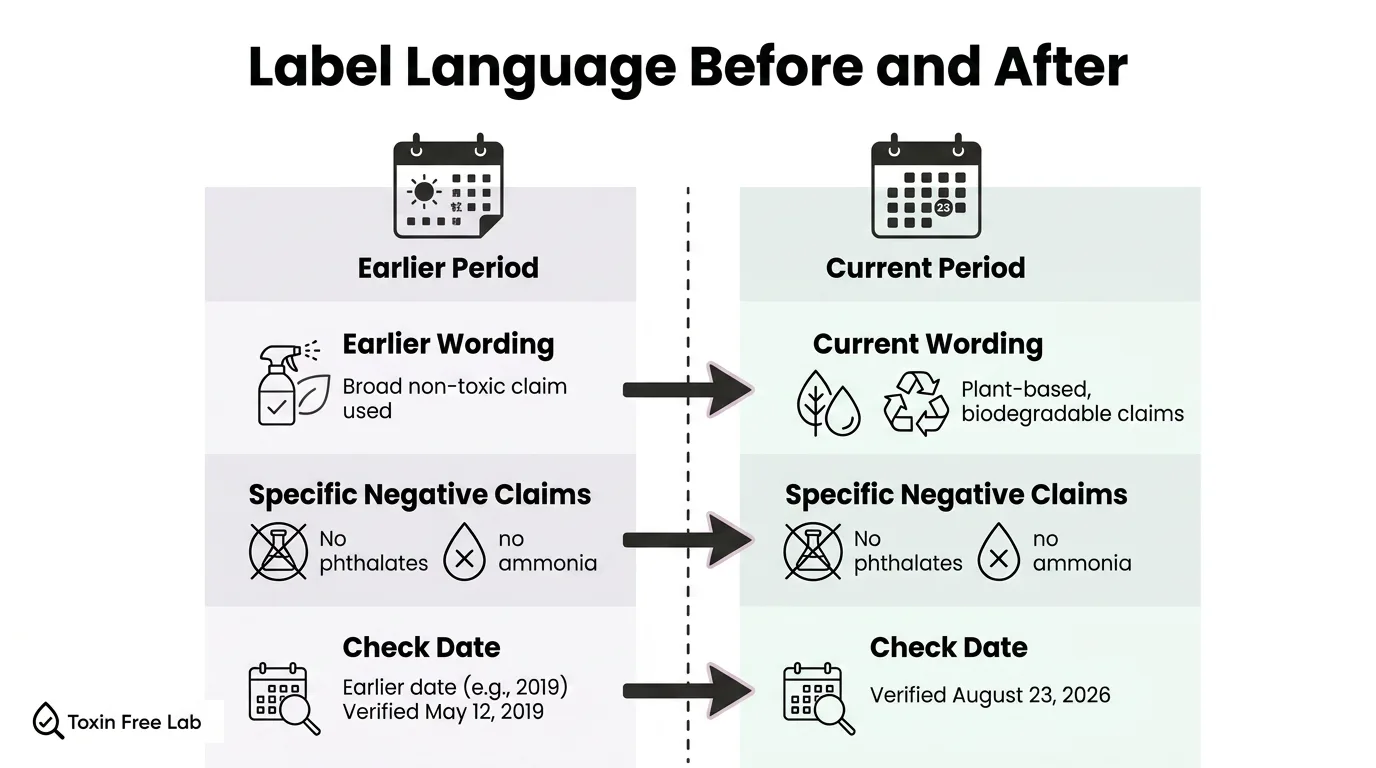
The settlement undertaking applied to three named products. It did not remove the phrase from the wider market, and it did not require a reformulation.
Retail listings for Method all-purpose surface cleaner still carry the phrase in on-pack copy, describing “non-toxic plant-based Powergreen technology” and a line about powerful non-toxic cleaning not being a myth. Some retailers carry the words in the product title itself. Consumer reviews published in 2026 quote the same wording from bottles in hand.
Two things follow. A labelling undertaking is specific to the products and claims it names, and it does not travel to a company’s other lines or to other brands. And a shopper cannot tell from the word itself whether a bottle predates the settlement, falls outside its scope, or simply uses different wording — because the word carries no defined meaning in either case.
How to check your own bottle
The settlement class covers purchases made between 14 May 2016 and 13 May 2021. That is a purchase date, not a way to identify which label a given bottle carries — label copy and formulation change independently of each other, so a product can carry new wording on an unchanged formula or the reverse.
The only reliable answer for your bottle is the bottle. Read the label in hand, then cross-reference it against Method’s current product page for that exact item and its published ingredient list.
The Bottom Line
S.C. Johnson agreed to stop calling three named Method products “non-toxic” after litigation, without admitting the products are harmful. Both facts are true at once, and neither cancels the other out.
The $2.25 million settlement resolved a labelling dispute over a legally undefined word, paired with six named chemicals a court never ruled toxic or safe. This article documents that dispute. It does not tell you how well any Method product cleans, and it does not rate any ingredient’s risk at the concentration used in the bottle. For pet-safety or child-safety questions the right source is Method’s published ingredient list and safety data sheet, alongside a qualified professional — not a lawsuit summary.
The one action worth taking: check the current label and Method’s published ingredient list for your exact product and purchase date, instead of relying on either the word “non-toxic” or the fact of a past lawsuit to decide for you.
How this audit was built: the court filings named above, Method’s published ingredient disclosures, and the American Contact Dermatitis Society’s 2013 allergen classification. Toxin Free Lab has not tested this product — it has no laboratory and performs no physical testing of cleaning products or any consumer product. Read our full methodology.
Frequently Asked Questions
Did S.C. Johnson admit Method products are toxic?
No. A settlement resolves a dispute without a court ruling on liability or fault. S.C. Johnson agreed to stop using the word “non-toxic” on three named Method products, which is a labelling commitment, not an admission that any product caused harm or contained a dangerous level of any chemical.
Which Method products were part of the settlement?
The complaint named three: the All-Purpose Cleaner, the Squirt and Mop Floor Cleaner and the Granite Cleaner. The settlement class covered US buyers who purchased one of these between 14 May 2016 and 13 May 2021. Other Method products were not part of this case.
Is Method All-Purpose Cleaner a disinfectant?
It is not marketed or registered as a disinfectant or antibacterial product. It is sold as a cleaner for lifting dirt and grease, and it makes no claims about killing bacteria or viruses. A product intended to sanitise must carry an EPA registration for that purpose; check the label for one.
What does Method’s label say about use around pets?
Read the product’s own label and safety data sheet, both of which Method publishes, and follow the handling and storage directions printed there. This site does not assess whether any cleaning product is safe around animals. If your pet has been exposed to a cleaning product, contact a veterinarian.
Is “non-toxic” regulated for any other cleaning brands?
No. No US agency, including the FDA, EPA or Consumer Product Safety Commission, defines or certifies “non-toxic” for any household cleaning brand. That is why similar claims from other companies remain legally usable unless individually challenged — a pattern also covered in the Seventh Generation brand audit.
Checking something else?
Every audit here works the same way: what the manufacturer publishes, what independent bodies say about it, and what the label leaves out.
All brand auditsSearch by chemicalHow we audit