Is Febreze Toxic? “Unscented” Drops Only 2 of 12 Ingredients
Is Febreze toxic? No regulator has classified Febreze as a toxic product, and its own label lists every ingredient except the makeup of “Fragrances.” The finding most pages miss: the Unscented Fabric Refresher drops only two of twelve label lines, fragrance and one solvent. The EPA-registered antimicrobial quat and the isothiazolinone preservative stay. Poison Control says brief inhalation of small amounts is usually not dangerous.
Methodology: this audit is built from the Febreze label as published by retailers, Procter & Gamble’s own ingredient pages, EWG’s Guide to Healthy Cleaning, EPA records, a P&G safety data sheet and Poison Control guidance. Toxin Free Lab performed no testing of any Febreze product and has no access to the fragrance formulation.
Key Findings
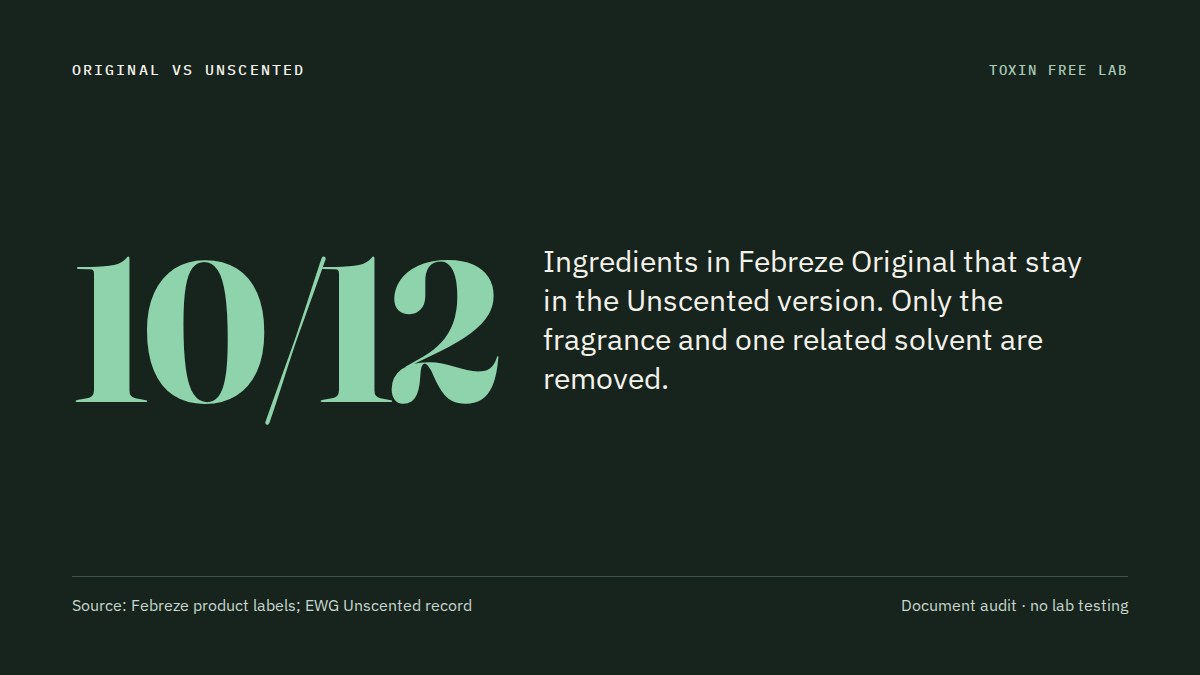
- The Extra Strength Original Fabric Refresher label lists 12 ingredients; “Fragrances” is the only line that hides a mixture.
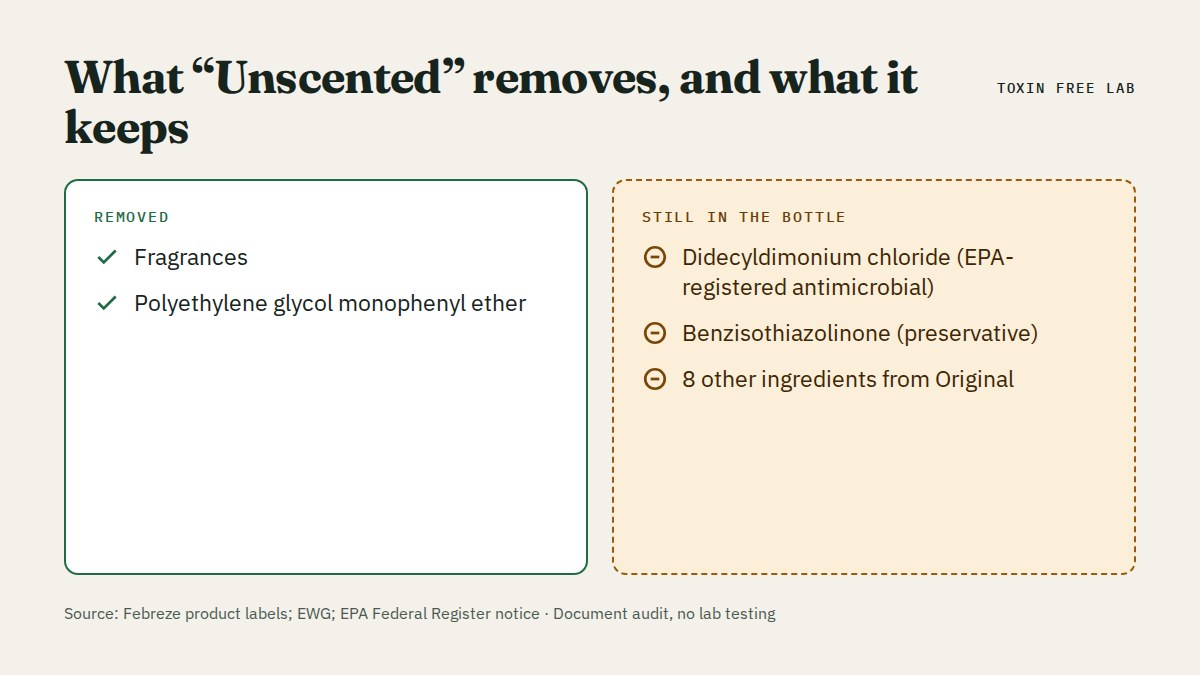
- “Unscented” is not “fewer chemicals.” EWG’s record for the Unscented version shows 10 ingredients. The difference is two lines.
- Didecyldimonium chloride, present in both, is a quaternary ammonium antimicrobial the EPA regulates as a pesticide active.
- The most-quoted statistic online, 89 air contaminants, comes from a 2009 EWG test of a different product line, Febreze Air Effects.
- The same product line tested free of phthalates in NRDC’s 2007 study. Few pages repeat that half.
What the Febreze Label Actually Lists
Most “is Febreze toxic” pages argue about fragrance in the abstract. The bottle is more specific than that. H-E-B reproduces the Extra Strength Original Scent Fabric Refresher label in full, and EWG publishes the Unscented formula with a concern grade on each line. Put side by side, the two formulas are nearly identical.
| Ingredient (label name) | Original Extra Strength | Unscented | EWG grade / listed concern |
|---|---|---|---|
| Water | Yes | Yes | A |
| Alcohol Denat. | Yes | Yes | A |
| Polyethylene Glycol Monophenyl Ether | Yes | No | Not graded on the Unscented record |
| Hydroxypropyl Cyclodextrin | Yes | Yes | C |
| Fragrances | Yes | No | Components not itemised on the bottle |
| PEG-11 Methyl Ether Dimethicone | Yes | Yes | D: biodegradation, developmental/endocrine/reproductive effects, aquatic toxicity |
| PEI-700 | Yes | Yes | C |
| Didecyldimonium Chloride | Yes | Yes | C: developmental/reproductive, nervous system effects |
| PEG-60 Hydrogenated Castor Oil | Yes | Yes | D: skin irritation, cancer, respiratory effects |
| Sodium Citrate | Yes | Yes | A |
| Sodium Maleate (Maleic Acid, Disodium Salt) | Yes | Yes | C: respiratory effects, skin irritation |
| Benzisothiazolinone | Yes | Yes | C: acute aquatic toxicity, skin irritation/allergies |
Credit where it is due. Febreze prints a full ingredient line on a product category where the law does not require one, and P&G’s chemical ingredients page explains what the core actives do: sodium citrate neutralises odour pH, cyclodextrin traps odour molecules. EWG gave the Unscented version an overall B. That is a mid-table result, not a fail.
“Unscented” Removes Two Lines, Not the Concern List
Buyers who react to Febreze often switch to Unscented on the assumption it is the stripped-down version. Count the lines.
Original lists 12. Unscented lists 10. The two removed are Fragrances and Polyethylene Glycol Monophenyl Ether. EWG grades seven Unscented ingredients C or D, and attaches a named concern to five of them. All seven are also in the Original. So the switch removes the fragrance mixture and leaves every C- or D-graded ingredient in place: 7 of 7.
The practical consequence: if a reaction is triggered by scent, Unscented addresses the likely cause. If it is triggered by skin contact with a preservative or quat, Unscented changes nothing. Benzisothiazolinone belongs to the isothiazolinone preservative family that EWG flags for skin allergies, and it appears in both. The same pattern turned up in our Dawn ingredient audit, where “Free & Clear” removed the dye and kept the preservative.
The Antimicrobial Most Pages Skip
Didecyldimonium chloride (DDAC) is not a fragrance or a solvent. The EPA describes DDAC as “an antimicrobial used in indoor and outdoor hard surfaces, eating utensils, laundry, carpets” and regulates it under pesticide law. In its 2006 reregistration decision, the agency found DDAC products eligible for reregistration “provided the risks are mitigated” as described in that decision.
That is a regulated-with-conditions status, neither a ban nor an endorsement. Reporting it matters because it changes how a fabric spray should be read. A product carrying a registered antimicrobial ingredient is doing more than masking smell, and the label’s own directions reflect that: “Keep out of reach of children and pets. Do not spray directly toward face. If eye contact occurs, rinse well with water.”
P&G’s safety data sheet for the Fabric Refresher (issue date January 2012, the version retrieved) lists ethyl alcohol at 1–5% as the only hazardous component and rates health hazard as “1 (Slight).” Its first aid for inhalation is “Remove to fresh air.” Check for a current revision before relying on the 2012 figures.
Where the “89 Chemicals” Claim Comes From
Nearly every critical page ranking for this query repeats one figure. EWG reports that in its 2009 study of school cleaning supplies, Febreze Air Effects released “a total of 89 airborne contaminants, including acetaldehyde,” which EWG describes as “a likely human carcinogen according to the EPA.”
Here is the complication. Two years earlier, NRDC tested 14 air fresheners and found phthalates in 12. Febreze Air Effects was one of the two with none detected. NRDC also found phthalates in products marketed as “all-natural” and “unscented.”
| Study | Year | Product | What it reported |
|---|---|---|---|
| NRDC air freshener study | 2007 | Febreze Air Effects | No phthalates detected; 12 of 14 products tested contained them |
| EWG school cleaning study | 2009 | Febreze Air Effects | 89 airborne contaminants, including acetaldehyde |
| P&G disclosure commitment | Announced 2017 | All fragranced products, US and Canada | Fragrance ingredients listed online down to 0.01% by end of 2019 |
Both findings are real, both concern a formula more than 15 years old, and neither tested the Fabric Refresher on shelves now. The fair reading: they show what one aerosol emitted at one point, not what today’s bottle contains.
What Is Disclosed, and What Is Still Withheld
In August 2017, P&G committed to “list all fragrance ingredients down to 0.01 percent” across its US and Canadian portfolio by the end of 2019, with Febreze among the first examples. That is further than most competitors go, and the “fragrance loophole” argument made on older pages is weaker for Febreze than for brands that disclose nothing.
What stays withheld: the proportions of each ingredient, any fragrance component below the 0.01% line, and the fragrance breakdown on the bottle itself, which still reads as one word. P&G’s own ingredient page also states: “It is not recommended to use Febreze around pets with sensitivities to scented products and aerosols, like birds.” If you are comparing brands on disclosure depth, our audits of Method and Mrs. Meyer’s use the same disclosed-versus-withheld frame.
For exposure questions, Poison Control states that “inhaling small amounts of most air fresheners is usually not dangerous,” that brief inhalation “might cause some coughing, choking, or difficulty catching one’s breath,” and that the line is 1-800-222-1222. Anyone with asthma, a reactive pet, or a young child should read the label and SDS and ask a physician or veterinarian.
The Bottom Line
No regulator record we found classifies Febreze as a toxic product, and it discloses more than most air-care brands: a full label and an online fragrance list to 0.01%. What it does not remove in the Unscented version is the part most people never check: a registered antimicrobial quat, an isothiazolinone preservative and two PEG ingredients. If scent is your trigger, Unscented helps. If skin contact or preservatives are, read the label line by line instead of the front of the bottle.
Frequently Asked Questions
Is Febreze toxic to breathe?
Poison Control states that inhaling small amounts of most air fresheners is usually not dangerous, though brief inhalation of a spray may cause coughing or difficulty catching one’s breath. The Febreze label says not to spray toward the face. People with asthma or fragrance sensitivity should check the SDS and ask a physician.
Is Febreze safe for cats and dogs?
That is a question for your veterinarian, not a label. The Febreze label says to keep the product out of reach of pets, and P&G’s own ingredient page advises against using Febreze around pets sensitive to scented products and aerosols, naming birds specifically. For suspected exposure, contact a vet or an animal poison line.
Does Febreze contain phthalates or formaldehyde?
Neither appears on the Fabric Refresher label. P&G lists phthalates among ingredients Febreze does not use, and NRDC’s 2007 study detected no phthalates in Febreze Air Effects. TFL has not tested any product, and label absence is not an independent emissions measurement.
Is Febreze Unscented a lower-ingredient option?
Only slightly. EWG’s record shows 10 ingredients against 12 on the Extra Strength Original label. Fragrances and one solvent are removed; the quat antimicrobial, benzisothiazolinone preservative and both PEG ingredients remain. It suits scent sensitivity more than preservative sensitivity.
Where can I see Febreze fragrance ingredients?
P&G committed in 2017 to publish fragrance ingredients down to 0.01% online for its US and Canadian products, including Febreze. The bottle itself still lists only “Fragrances.” Proportions of each ingredient are not published.
Checking something else?
Every audit here works the same way: what the manufacturer publishes, what independent bodies say about it, and what the label leaves out.
All brand auditsSearch by chemicalHow we audit