Non-Toxic Air Freshener: What the Label Can’t Tell You
A non-toxic air freshener is not something a label can promise, because no U.S. rule defines the term and most fragrance chemistry never reaches the label. Peer-reviewed emissions work by Anne Steinemann found that fewer than 10% of volatile ingredients in air fresheners are typically disclosed on labels or safety data sheets. The useful question is narrower: how much does a product disclose, which certification backs it, and does it need fragrance at all?
Methodology: Toxin Free Lab performed no testing on any product in this guide. It is built from peer-reviewed emissions and survey research, EPA and California disclosure rules, and published certification criteria, all linked below.
Why “Non-Toxic” on an Air Freshener Tells You Almost Nothing
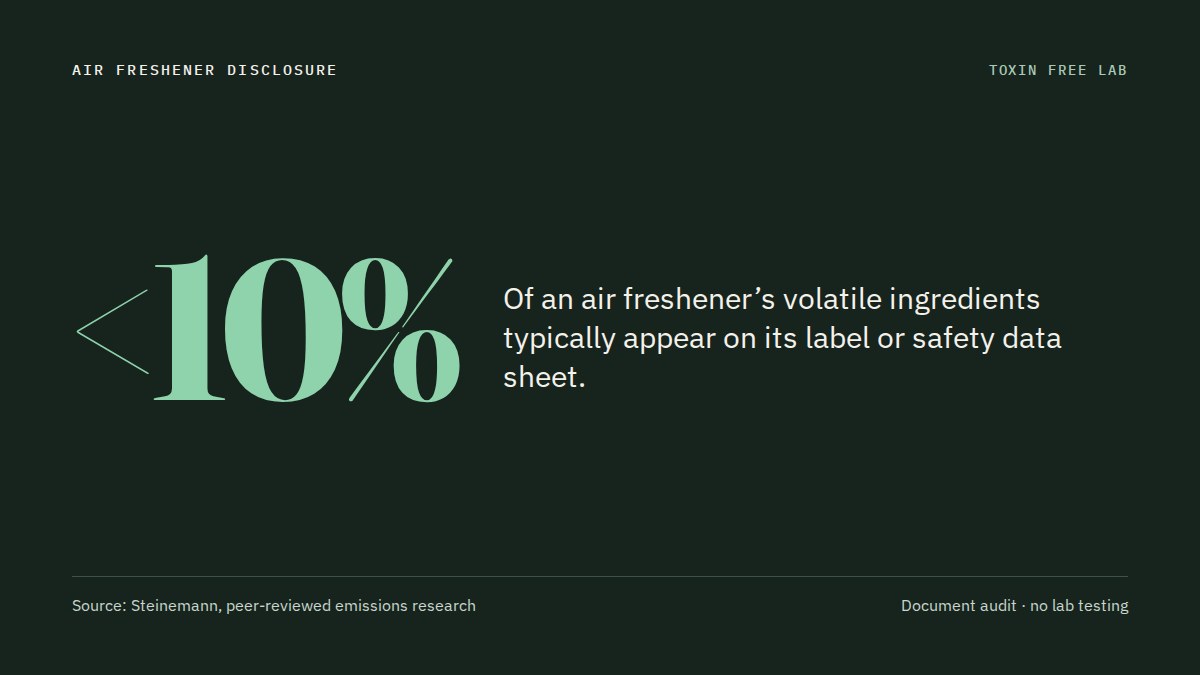
Air fresheners have a disclosure problem before they have a chemistry problem. Steinemann’s 2017 review in Building and Environment lists the compounds air fresheners were found to emit: terpenes such as limonene and alpha-pinene, terpenoids such as linalool, and also ethanol, formaldehyde, benzene, toluene and xylene. The same paper reports that fewer than 10% of volatile ingredients are typically disclosed on labels or material safety data sheets.
An earlier Steinemann study of six best-selling products, three of them air fresheners, identified nearly 100 volatile organic compounds. Ten were regulated as toxic or hazardous under federal law. None appeared on any product label, and one appeared on one safety data sheet.
Here is the complication. The 2017 review also reports that products marketed as environmentally friendly did not perform better than conventional ones on hazardous emissions. The word on the front of the bottle and the emissions from the bottle are separate facts. A shopper can only act on what is written down, so disclosure is the first filter.
What the Label Law Actually Forces Brands to Show
California’s Cleaning Product Right to Know Act (SB 258) is the strongest disclosure rule most U.S. shoppers will meet, and it names “air care product” as a covered category. According to the Acta Group summary of the law, online ingredient disclosure applied from January 1, 2020 and label disclosure from January 1, 2021.
The fragrance rule is the part most guides skip. Listed fragrance allergens must be disclosed at or above 0.01%, which is 100 parts per million. Under one labelling option, the remaining fragrance components can still be grouped as “fragrance.”
Do the arithmetic on a small refill. Take a hypothetical 20 ml plug-in refill holding roughly 20 g of liquid. The 0.01% threshold works out to 2 mg (20,000 mg × 0.0001). A listed allergen present below 2 mg in that refill does not have to be named, and any fragrance component that is not on the allergen list can sit inside the single word “fragrance” whatever its amount. So a fully compliant label can still leave most of the scent formula unnamed.
The practical consequence: a brand that lists every fragrance component by name, or publishes a full SDS, is going beyond what the law requires. That gap between required and voluntary disclosure is the most useful comparison a shopper can make.
Which Certifications Mean Something on Home Fragrance
Two programs publish criteria that apply directly to fragrance. EPA’s Safer Choice Criteria for Fragrances exclude listed carcinogens, mutagens and reproductive or developmental toxicants, listed persistent bioaccumulative toxic compounds, and listed respiratory sensitizers, and they require manufacturers to disclose dermal sensitizers. EWG runs a separate EWG Verified fragrance category and a graded air freshener database.
Neither is a toxicity verdict on a product. Each tells you that a named body checked the formula against its own published list. That is more than a front-label adjective can tell you, and it is checkable: search the product on the register before buying.
| What to look for | What it establishes | What it does not establish |
|---|---|---|
| “Non-toxic,” “natural,” “clean” on the label | A marketing claim | Any defined standard; no U.S. rule sets one |
| “Fragrance” as a single ingredient | Scent is present | Which compounds make it up |
| Fragrance allergens named (SB 258) | Listed allergens at or above 100 ppm | Non-allergen fragrance components |
| EPA Safer Choice label | Fragrance screened against EPA’s excluded-chemical lists; dermal sensitizers disclosed | What the product emits in your room |
| EWG Verified | Formula met EWG’s published criteria and was disclosed to EWG | Emissions under real-room conditions |
| Fragrance-free | No added scent | That the product removes odor |
For brand-level examples of how this plays out, see our audits of Pura’s diffuser ingredient disclosures, Method’s fragrance labelling and Mrs. Meyer’s scent ingredients.
Plug-In Air Freshener Alternatives, Ranked by How Much You Can Verify
Plug-ins run continuously, so the disclosure question matters more for them than for a spray used once. Terpenes are the other reason. A Lawrence Berkeley National Laboratory study by Destaillats and colleagues found that when terpene-containing household products mixed with ozone, formaldehyde was a predominant byproduct and ultrafine particles formed. Limonene and pinene, often sold as plant-derived, are terpenes. Plant origin and emission behaviour are separate questions.
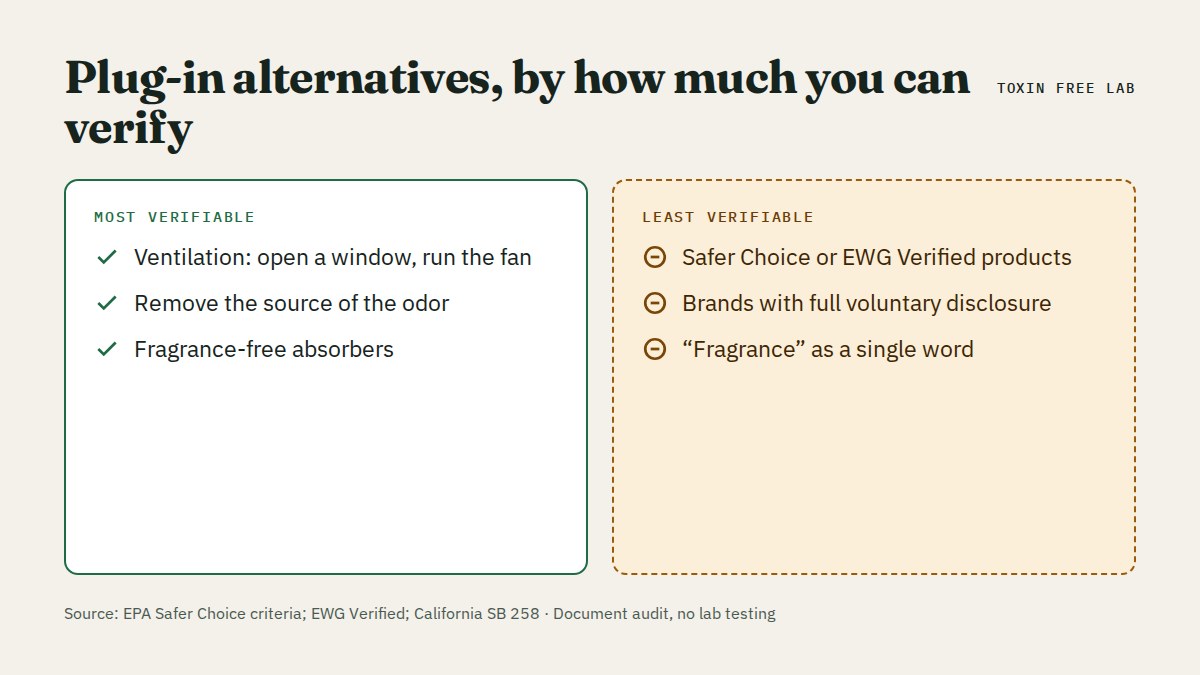
These plug-in air freshener alternatives are ordered by how much of what enters the air you can check, not by preference:
- Ventilation. EPA’s VOC guidance advises increasing ventilation when using products that emit VOCs, and notes indoor levels of many VOCs run consistently higher than outdoors. Opening a window or running an exhaust fan adds nothing to the air.
- Remove the odor source. EPA frames source control as a core step. Trash, drains, litter and damp fabric are fixed, not masked.
- Fragrance-free absorbers. Baking soda or activated-charcoal bags add no scent compounds. Buyers commonly describe them as slow and suited to small spaces such as closets.
- A certified scented product. If you want scent, a Safer Choice or EWG Verified listing means the formula was screened against published criteria.
- A scented product with full voluntary disclosure. Every component named or an SDS published, but no third-party screen.
- “Fragrance” listed as one word. Least verifiable, whatever the front label says.
Who Notices Air Fresheners Most
Steinemann’s U.S. survey data put this in household terms. In the 2017 review, 20.4% of respondents reported health problems when exposed to air fresheners and deodorizers, including respiratory problems (9.5%), mucosal symptoms (7.6%) and migraine headaches (7.2%). Her 2016 paper in Air Quality, Atmosphere & Health reports that 20.2% would leave a business quickly if they smelled air fresheners there.
These are self-reported survey figures, not measured exposures, and they do not identify any brand. They do mean that in a household of five, the odds that someone reacts to scent are not small. If anyone at home has asthma, migraines or fragrance sensitivity, or if you keep birds or other pets, read the product’s SDS and ask a physician or veterinarian before running a continuous diffuser.
The Bottom Line
No label can settle whether an air freshener is non-toxic, and the research shows most emitted compounds go unlisted. Rank options by what you can verify: ventilation and odor removal first, fragrance-free absorbers next, then scented products with Safer Choice or EWG Verified listings, then those with full voluntary disclosure. A product listing only “fragrance” gives you the least to check, regardless of what its packaging claims.
Frequently Asked Questions
Is there such a thing as a non-toxic air freshener?
No U.S. rule defines “non-toxic” for air fresheners, so the word is a marketing claim. What you can check is disclosure and certification: whether every fragrance component is named, whether an SDS is published, and whether the product appears on the EPA Safer Choice or EWG Verified registers.
What can I use instead of a plug-in air freshener?
EPA’s indoor-air guidance points to ventilation and removing the odor source. Fragrance-free baking soda or activated-charcoal absorbers add no scent compounds. If you want scent, choose a product with a Safer Choice or EWG Verified listing, or one that names every fragrance component.
Are essential oil air fresheners automatically better?
Not automatically. Essential oils contain terpenes such as limonene and pinene, and Lawrence Berkeley National Laboratory research found terpene-containing products reacting with ozone formed formaldehyde and ultrafine particles. Plant origin describes where an ingredient came from, not how it behaves in room air.
Why don’t air freshener labels list every ingredient?
Disclosure law allows grouping. Under California SB 258, listed fragrance allergens must be named at 0.01% (100 ppm) or above, while other fragrance components can be listed collectively as “fragrance.” Steinemann’s research reports that fewer than 10% of volatile ingredients typically appear on labels or safety data sheets.
Are air fresheners a concern around pets or children?
Survey research finds a meaningful share of adults report symptoms from air fresheners, but it does not rate specific brands. Read the product’s label and SDS for warnings, and ask your pediatrician or veterinarian before using a continuous diffuser around children, birds or other pets.
Checking something else?
Every audit here works the same way: what the manufacturer publishes, what independent bodies say about it, and what the label leaves out.
All non-toxic productsSearch by chemicalHow we audit