Is Caraway Non-Toxic? What the NAD Ruling Really Says
Key findings
- NAD cleared Caraway's claims about its own cookware, but not its claims about competitor cookware.
- NAD is an advertising self-regulatory body, not a government safety regulator. It cannot test, certify, fine or recall.
- The challenger was the Cookware Sustainability Alliance, a coalition whose members make PTFE-coated pans.
- Caraway said it disagrees with the recommendation but will comply.
- "Non-toxic" still has no legal definition in the US, regardless of this ruling.
Caraway’s ceramic cookware markets itself as non-toxic, and most articles stop at whether that claim is true. The real story is a reversal almost nobody covers.
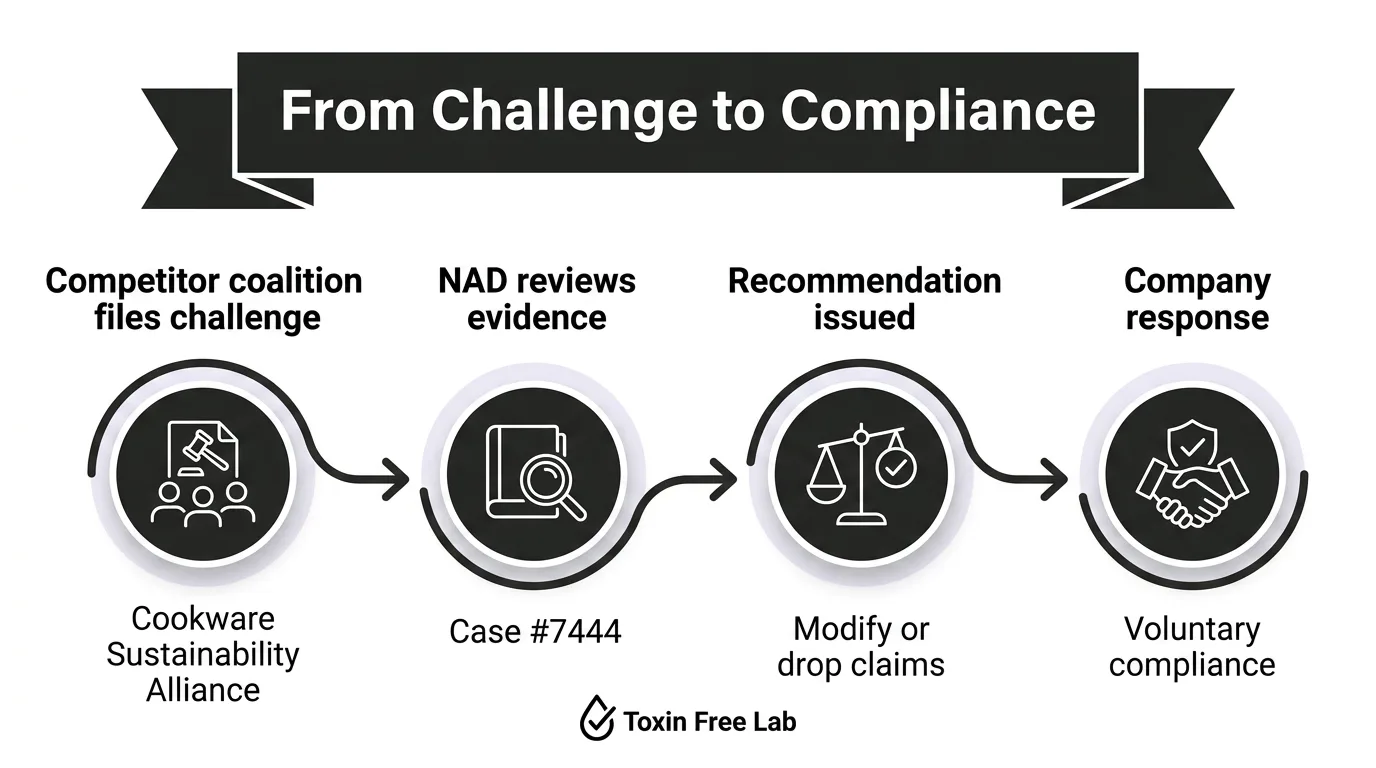
In August 2025 the National Advertising Division reviewed Caraway’s marketing in Case #7444 and found the company had a reasonable basis for calling its own cookware “non-toxic” and “free of PFAS.” What NAD struck down was not Caraway’s description of itself. It was what Caraway said about everyone else’s cookware, including a broad claim that traditional nonstick pans release toxins when overheated.
This was an advertising dispute decided by an industry self-regulatory body, not a government safety verdict. Toxin Free Lab audits published brand documentation and regulatory case records rather than testing products, and this article covers what NAD actually decided, who brought the challenge, what the ruling does and does not establish, and what it means for traditional nonstick cookware.
What Did the National Advertising Division Actually Rule On Caraway?
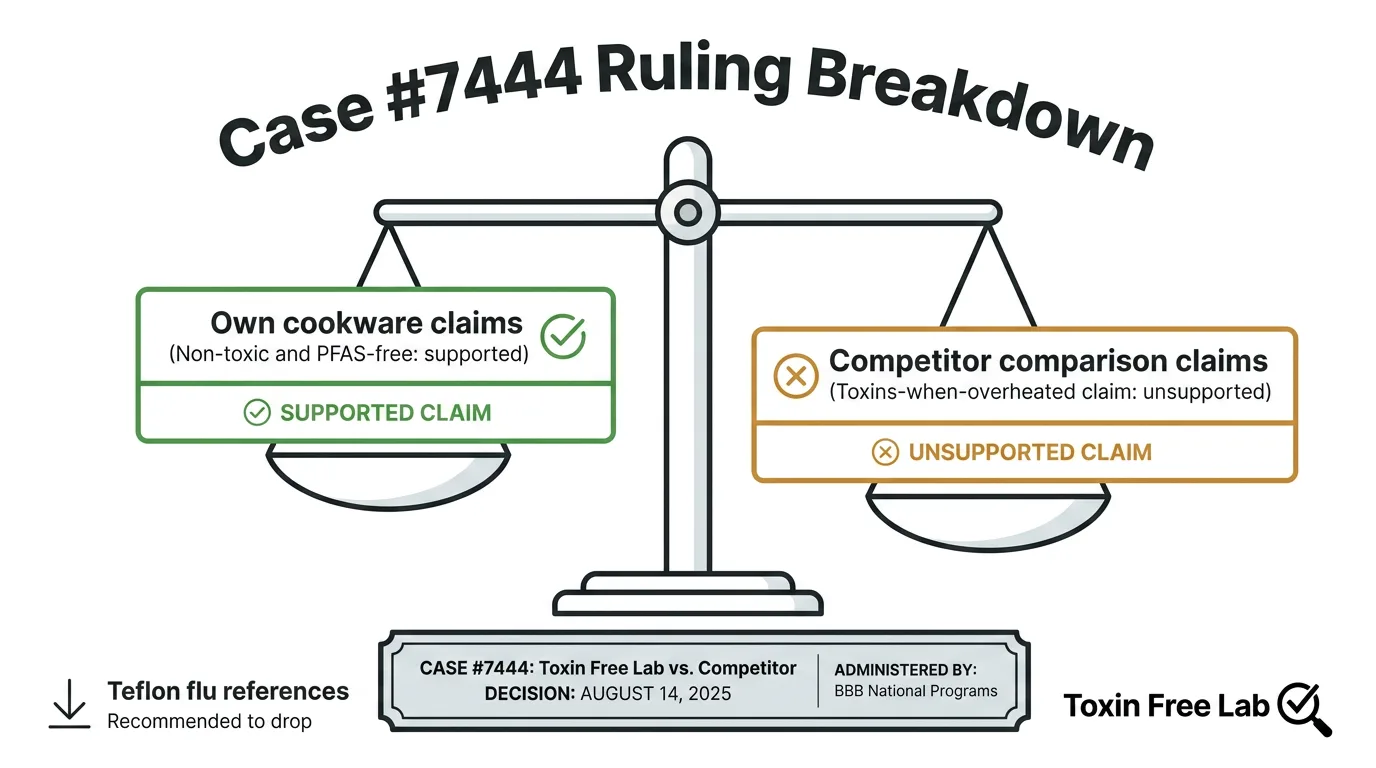
NAD reviewed two separate categories of Caraway advertising in Case #7444, decided August 14, 2025, and administered by BBB National Programs. One category covered claims Caraway made about its own cookware. The other covered claims Caraway made about traditional nonstick cookware in general. The outcome split cleanly between the two.
Caraway’s self-description survived the review. Its comparisons to other brands’ products did not, and NAD recommended the company change or drop that language.
| Claim category | NAD outcome | What it means |
|---|---|---|
| “Free of PFAS” — about Caraway’s own cookware | Reasonable basis found | The evidence Caraway submitted was judged adequate for this claim |
| “Non-toxic” — about Caraway’s own cookware | Reasonable basis found | A substantiation finding, not a safety certification |
| Traditional nonstick is harmful because of forever chemicals | Discontinue or modify | Comparative claim not supported on the record presented |
| Most traditional cookware releases toxins when overheated | Unsupported | Broad claim, insufficient evidence submitted |
| “Teflon flu” invoked against competitor cookware | Avoid in that context | Concerned advertising context, not whether the condition exists |
The Claims NAD Found Supported
NAD found Caraway had a reasonable basis for describing its own cookware as “free of PFAS” and “non-toxic.” That finding is about substantiation, meaning NAD looked at the evidence Caraway submitted for its own product claims and judged it adequate. It is not a certification that the cookware is safe in every sense. NAD tests whether a specific claim is supported by the record presented, not whether a product carries zero risk.
The Claims NAD Recommended Caraway Drop or Modify
NAD recommended Caraway discontinue or modify comparative claims implying traditional nonstick cookware is harmful because it contains forever chemicals. Specifically, NAD found the broad statement that most traditional cookware releases toxins when overheated unsupported by the evidence Caraway presented. NAD also recommended Caraway stop invoking “Teflon flu,” the informal term for polymer fume fever, in ways that implied competitor cookware is toxic. That combination is the part of this case most coverage skips entirely.
How Caraway Responded
Caraway said it disagrees with NAD’s recommendation but will comply with it, according to BBB National Programs’ case reporting. This is the standard resolution pattern for NAD cases. There is no fine and no court order involved. Voluntary industry compliance is the entire enforcement mechanism at this stage.
Who Challenged Caraway, and Why Does That Matter?
The challenge in Case #7444 came from the Cookware Sustainability Alliance, a coalition whose member companies manufacture PTFE-coated cookware. That detail changes how a reader should weigh this ruling. A group of PTFE pan makers challenging a competitor’s comparative marketing is a routine commercial dispute, not a consumer safety complaint or evidence that either side’s product is dangerous. Framed plainly, this was Caraway’s rivals pushing back on claims that made their own products look bad by comparison, and NAD agreed those specific claims went too far.
Why This Wasn’t a Consumer Complaint or a Safety Investigation
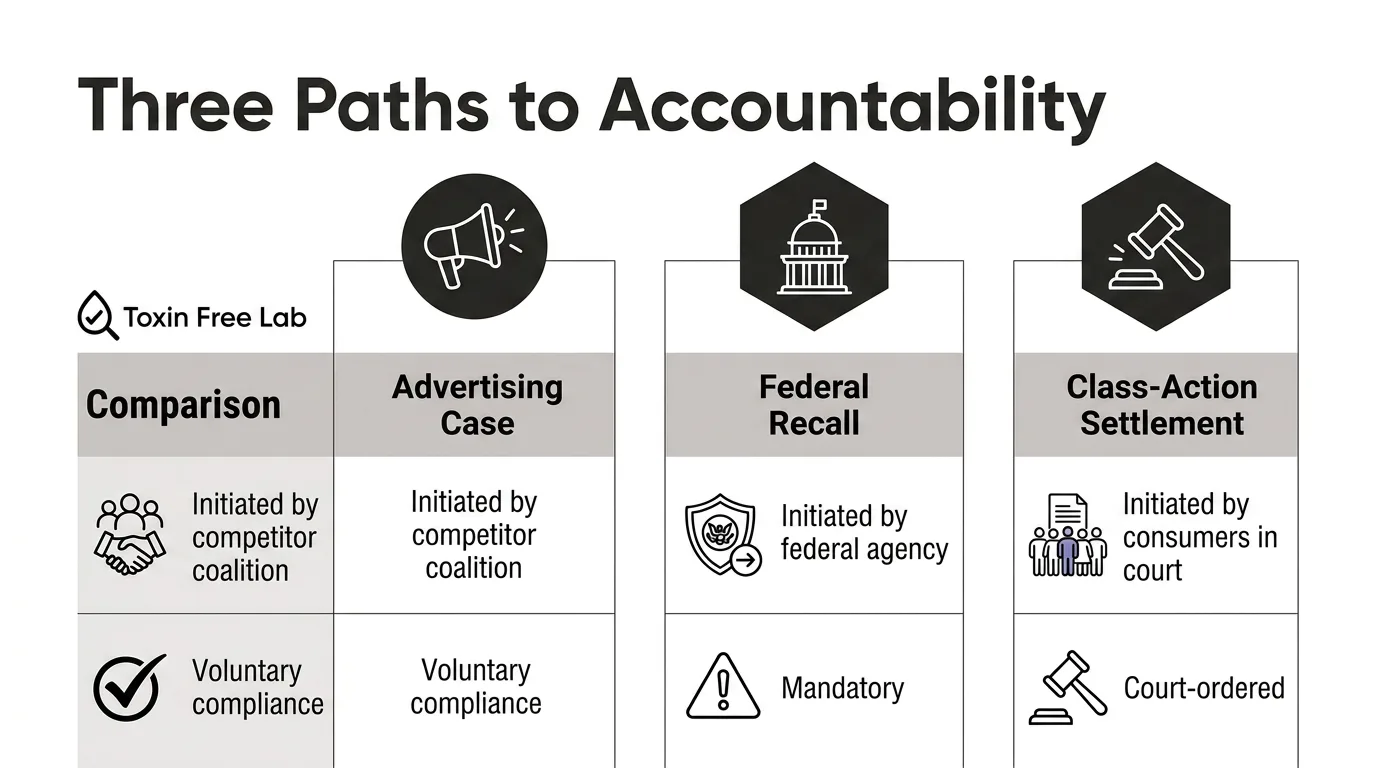
NAD proceedings are typically started by competitors or by NAD’s own advertising monitoring, not by individual consumers reporting a safety problem. That is a different mechanism from a CPSC recall like the one covering Pura, which addresses a physical product defect, or a class-action settlement like the one involving HexClad, which addresses labeling accuracy in court. Coverage that treats these three processes as interchangeable gets the mechanism wrong.
| Process | Who Initiates It | What It Addresses | Enforcement |
|---|---|---|---|
| NAD Case (Caraway) | Competitor coalition | Advertising claim substantiation | Voluntary compliance; FTC referral if refused |
| CPSC Recall (Pura) | Federal agency | Physical product defect | Mandatory |
| Class-Action Settlement (HexClad) | Consumers, via court | Labeling accuracy | Court-ordered terms |
Is NAD a Government Agency? What This Ruling Does and Doesn’t Establish
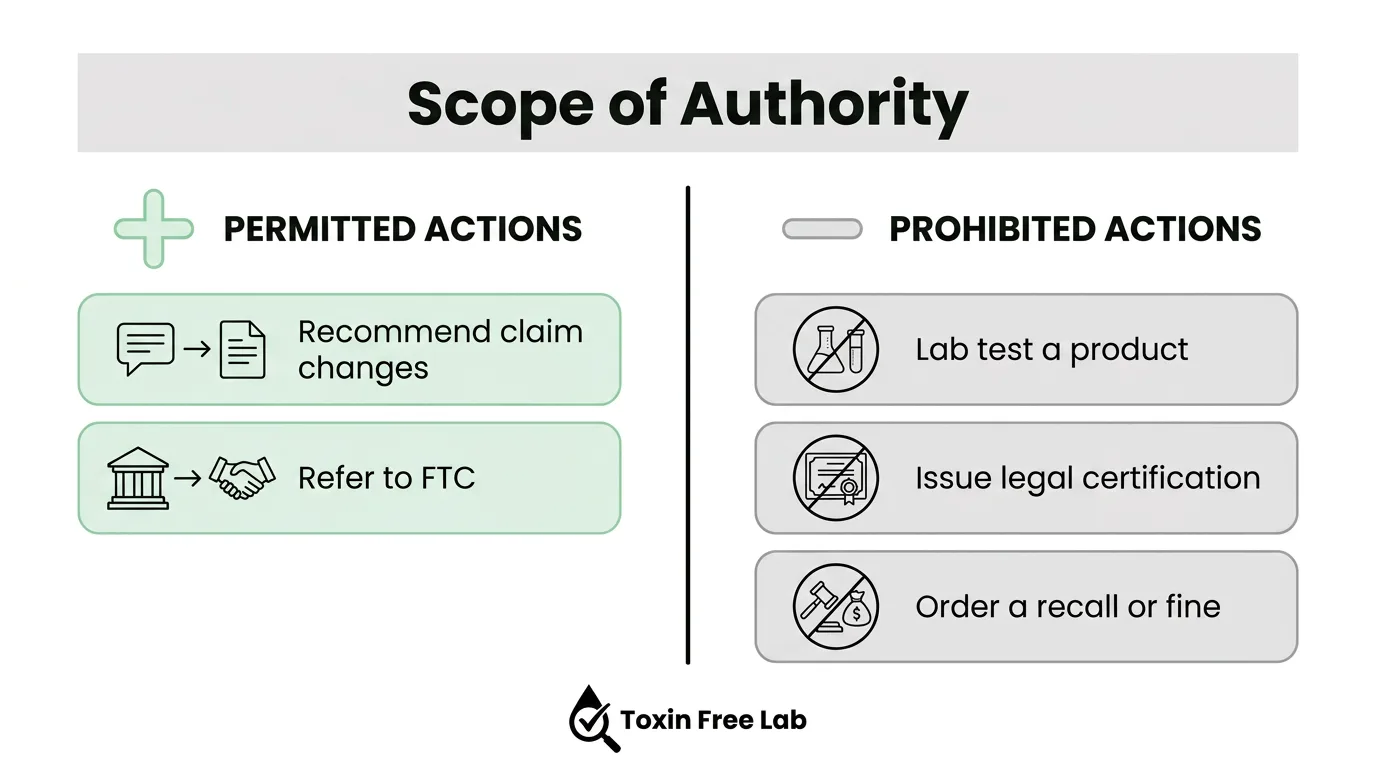
NAD is not a government agency. It is a self-regulatory body administered by BBB National Programs, and it has no authority to fine a company, order a recall, or ban a product from sale. That distinction matters because a NAD decision can sound like an official verdict when it is actually an industry-run review process. Regardless of how Case #7444 came out, “non-toxic” remains an undefined term under FDA, EPA and CPSC guidance, meaning no federal agency certifies any cookware as non-toxic the way the USDA certifies organic food.
What NAD Rulings Can and Cannot Do
NAD can recommend that a company modify or discontinue an advertising claim, and companies that refuse to comply can be referred to the Federal Trade Commission. What NAD cannot do is test a product, certify its safety, or determine legal liability. It reviews the evidence each side submits in an advertising dispute and issues a recommendation based on that record alone.
- Can: recommend a claim be changed or dropped
- Can: refer a non-compliant company to the FTC
- Cannot: test a product in a lab
- Cannot: issue a legal safety certification
- Cannot: order a recall or a fine
What Caraway’s Ceramic Coating Is, and What Case #7444 Didn’t Examine
Caraway’s separate claim that its ceramic coating is made without PTFE, PFOA or PFAS is an ongoing manufacturer disclosure, not something Case #7444 examined directly. The NAD case addressed advertising language and comparative marketing, not the coating’s chemical composition itself.
This article does not assess how the cookware cooks, how the coating wears, or where it is manufactured. On manufacturing location, Caraway’s own published statement is the only source Toxin Free Lab will use, and where a company has not published one, that disclosure gap is reported as a gap rather than filled with an assumption. That rule applies across every brand audit on this site.
What This Means For Traditional Nonstick and PTFE Cookware
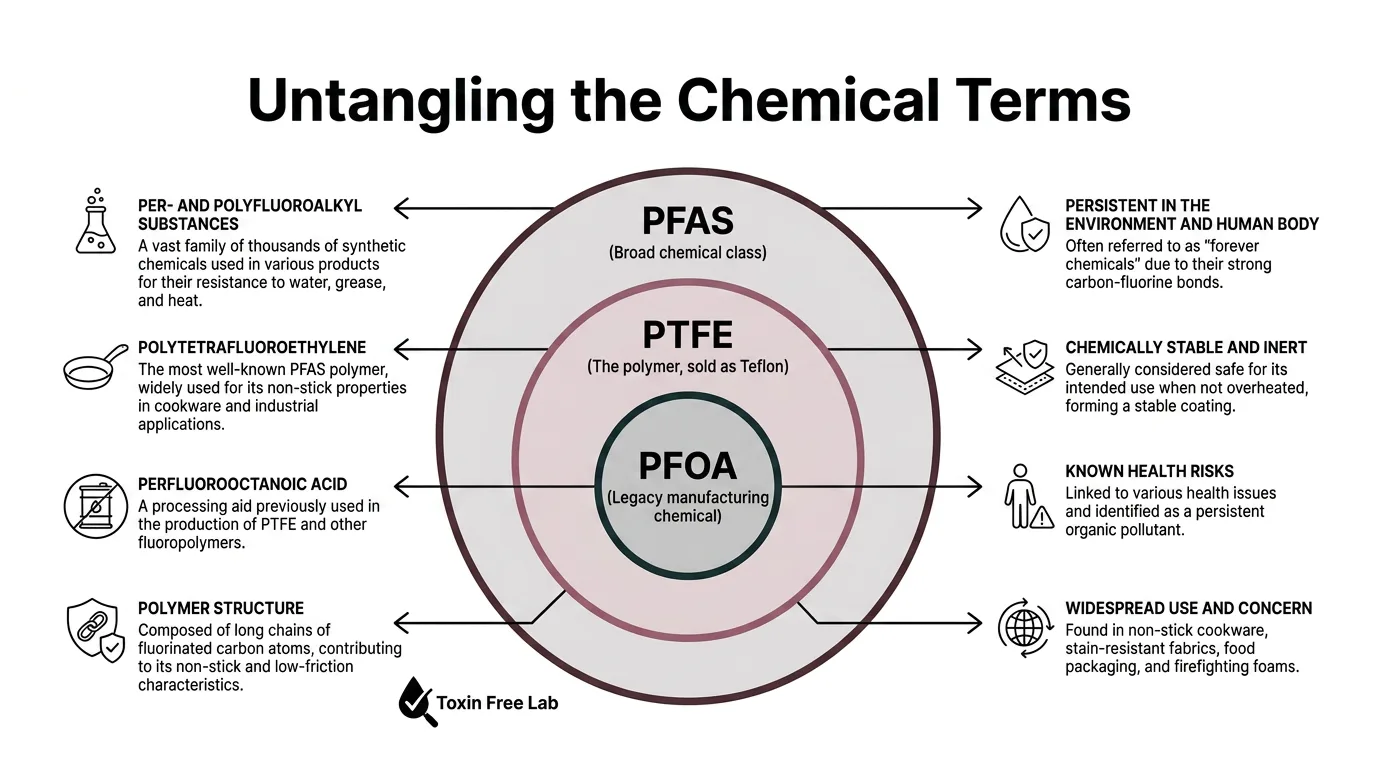
NAD’s finding was narrow. It said Caraway’s specific comparative claim lacked enough evidentiary support, and that is not the same as NAD ruling that PTFE cookware is safe. The three terms at the centre of this debate also get conflated constantly.
| Term | What it actually is | Relationship |
|---|---|---|
| PFOA | A legacy manufacturing chemical once used to produce PTFE | A single compound within PFAS; phased out of US cookware manufacturing |
| PTFE | The polymer itself, commonly sold under the Teflon brand name | A fluoropolymer, and therefore a PFAS |
| PFAS | The broad chemical class | Contains both PFOA and PTFE, plus thousands of other substances |
| Teflon | A brand name, not a compound | A trade name for PTFE coatings |
The comparative claim NAD reviewed treated nonstick cookware as a single category equivalent to a worst-case exposure scenario. Collapsing a chemical class into its most notorious member is the distinction NAD found unsupported on the record.
The Bottom Line
Caraway’s own non-toxic and PFAS-free claims held up under NAD’s review, while its claims about competitor cookware did not and were recommended for removal.
Neither outcome is a government safety certification, because no such certification exists for cookware in the US. If you are asking whether Caraway cookware is non-toxic, the honest answer is that its self-description survived scrutiny from an industry body with no legal authority — which is meaningfully different from an independent laboratory confirming the product carries no risk.
Treat this ruling as one data point, not the final word. The useful takeaway is narrower than the headline: a claim was tested against evidence, and half of it held.
How this audit was built: the NAD Case #7444 decision, Caraway’s published claims about PFAS and non-toxic materials, and BBB National Programs’ case reporting. Toxin Free Lab has not tested this product — it has no laboratory and performs no physical testing of cookware, coatings, or any consumer product. Read our full methodology.
Frequently Asked Questions
Are Caraway pans non-toxic?
Caraway’s “non-toxic” claim about its own cookware was reviewed by the National Advertising Division in 2025 and found to have a reasonable basis. That is a substantiation finding, not a safety certification. No US agency defines or certifies “non-toxic” for cookware, so no product carries an official version of that label.
What is NAD Case #7444?
NAD Case #7444 is a National Advertising Division decision, administered by BBB National Programs and decided on August 14, 2025. It found Caraway’s own non-toxic and PFAS-free claims reasonably supported, while recommending Caraway drop or modify comparative claims suggesting traditional nonstick cookware is harmful.
Did Caraway lose the NAD case?
Not in a simple win-or-lose sense. Caraway’s claims about its own cookware were upheld as reasonably supported. Only its comparative claims about competitor cookware were recommended for discontinuation, so the outcome is a split decision rather than a defeat for either side.
Does an NAD ruling mean a product is legally certified non-toxic?
No. NAD has no government authority and cannot issue a legal certification of any kind. The FDA, EPA and CPSC are the federal agencies most relevant to cookware, and none of them define or certify “non-toxic” as a product category or label.
How is this different from the HexClad PFAS lawsuit?
They are different mechanisms entirely. The HexClad case was a class-action settlement over labeling on PTFE-coated pans marketed as PFAS-free. Caraway’s case is an advertising self-regulation dispute over comparative marketing claims, brought by a competitor coalition rather than by consumers in court.
Checking something else?
Every audit here works the same way: what the manufacturer publishes, what independent bodies say about it, and what the label leaves out.
All brand auditsSearch by chemicalHow we audit